🌿 Fine dust slows spring greening: study points to clogged leaf pores
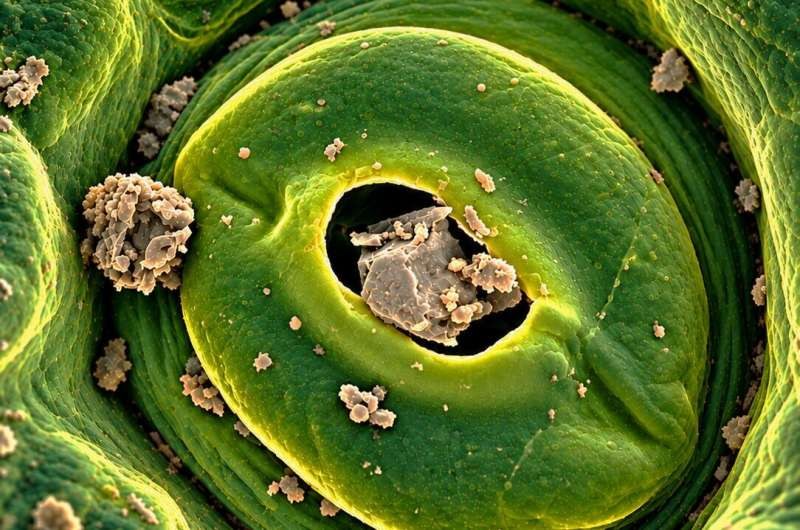
In brief
- 🌿 A Nature Plants study links higher fine-particle pollution (PM2.5) to weaker spring greening in about 60% of the vegetated areas studied.
- 🛰️ Basis: 7,046 air-quality stations worldwide and satellite records from 2000 to 2020.
- 🍃 Particles can block or damage leaf pores (stomata) and cut the light plants receive.
- 🌍 Plants then absorb less carbon; cleaner air would bring a double benefit.
🌿 Warmer springs and more carbon dioxide make plants green up earlier and more strongly, so the land absorbs more carbon. A study published in Nature Plants on 27 November finds an overlooked brake on this: fine particulate pollution, PM2.5. 🛰️ A team led by Wang Jian, Wu Chaoyang and Ge Quansheng of the Institute of Geographic Sciences and Natural Resources Research at the Chinese Academy of Sciences combined measurements from 7,046 air-quality stations around the world with satellite records of vegetation from 2000 to 2020. In about 60 percent of the vegetated grid cells analysed, more PM2.5 went along with weaker spring greening, even after accounting for carbon dioxide, temperature, rainfall and atmospheric dryness. According to the researchers, the effect was about as large as that of very dry air. 🍃 They point mainly to the leaves themselves: fine particles settle on them and can block or damage the stomata, the pores through which plants exchange gases, and the dust also dims the sunlight. Less photosynthesis in spring means less carbon taken up by land ecosystems. Cleaner air would therefore help the climate as well as human health, the authors say.
🔬 **Three measures instead of one.** The researchers did not rely on a single measure of greening. They analysed canopy greenness, the amount of leaves and solar-induced fluorescence, a faint glow of plants that is closely linked to photosynthesis. According to them, causal analyses indicated that PM2.5 actually influences vegetation activity rather than merely changing alongside it.
🧪 **Under the microscope.** To test the mechanism, the team examined the leaves of 15 tree species with an electron microscope, analysed data on 104 plant species worldwide in a meta-analysis, and added carbon-flux measurements from 187 sites. Higher pollution went along with lower stomatal conductance and lower photosynthetic rates. Stomata are the microscopic pores through which a leaf takes in carbon dioxide and releases water; when they clog, the plant works at reduced capacity.
⚖️ **Not harmful everywhere.** The effect is not uniform. In some regions the particles scatter sunlight, so more diffuse light reaches lower leaves, or they add nitrogen to the soil; both can occasionally even stimulate growth. These differences make forecasts difficult. Sixteen leading land-ecosystem models reproduced the overall negative relationship, but in about 30 to 40 percent of grid cells their spatial pattern disagreed with the observations.
🌍 **What follows.** If fine dust weakens spring photosynthesis, the land carbon sink shrinks, and climate projections that ignore this become less reliable. The authors therefore argue for treating air-quality improvement and cuts in greenhouse-gas emissions as complementary strategies. PM2.5 has so far been known mainly for harming human health; the study extends the picture to vegetation and the carbon cycle.
📄 **About the source.** This account is based on the Chinese Academy of Sciences' press release published by Phys.org. The paper itself, "PM2.5 air pollution weakens global spring greening" (DOI 10.1038/s41477-026-02464-9), was not freely readable for us; an earlier version appeared as a preprint in 2024 under the title "Air pollution weakens global spring greening". It is an observational study of statistical associations, supported by laboratory findings; how strong the effect is in individual regions remains uncertain, according to the authors.