🦀 Millions of red crabs begin their annual migration on Christmas Island
In brief
- 🌴 On Australia's Christmas Island, millions of red crabs began their march from forest to coast around November 14 and 15.
- 🚧 Estimates range from tens of millions to about 100 million animals; roads close, and bridges and underpasses help.
- 🌙 The crabs release their eggs into the sea before dawn on a falling tide in the moon's last quarter.
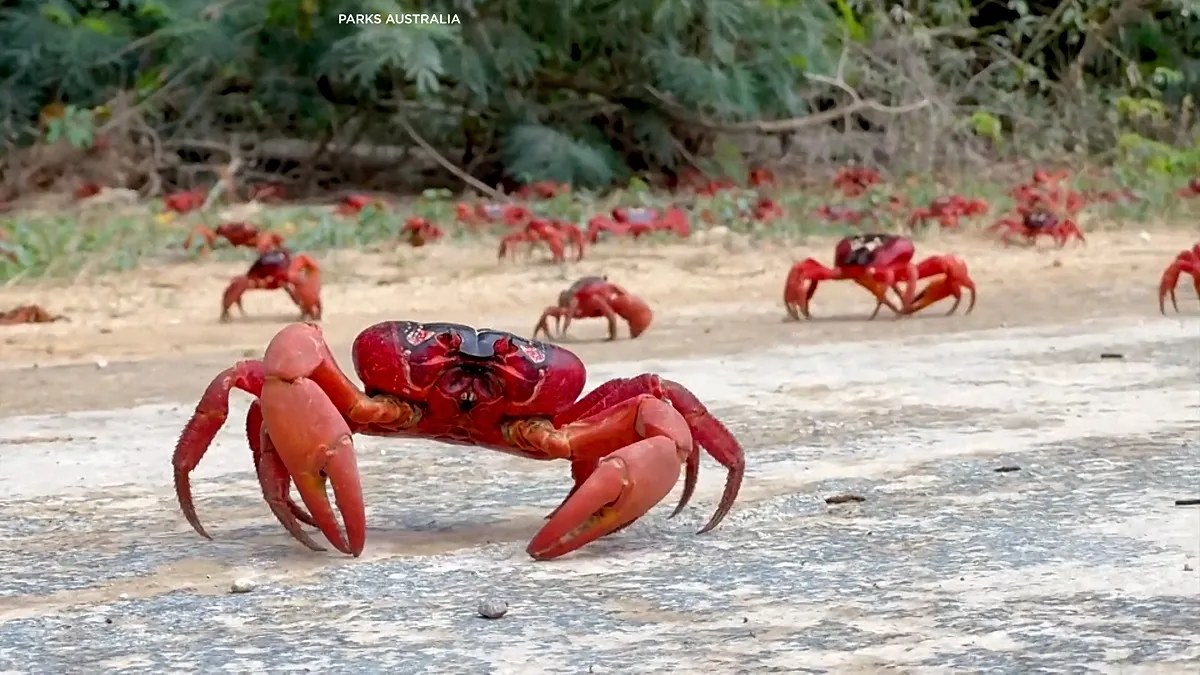
🏝️ On Australia's Christmas Island in the Indian Ocean, about 2,600 kilometers northwest of Perth, the annual red crab migration has begun. According to Euronews it started on November 14 and 15, 2026 after heavy wet-season rain. The animals move from the forest to the coast to mate and release their eggs into the sea. The number is given differently: Euronews writes of tens of millions of animals, ABC Australia of an estimated 100 million. The crabs time their egg release by the moon: they release the eggs into the water before dawn on a falling tide in the last quarter moon. Parks Australia closes roads, builds bridges and underpasses and sets up barriers along the routes; residents rake crabs out of the way of vehicles.
🌧️ Rain triggers the migration. Euronews describes the crabs setting off after the first heavy rains of the wet season; ABC Australia says it begins with the first rainfall of the wet season. They travel from their homes in the island's interior through the forest to the coast, where they mate and release their eggs into the sea. Christmas Island lies about 2,600 kilometers northwest of Perth. On numbers: Euronews says "tens of millions" of crabs in the text and "millions" in the subheadline; ABC gives an estimated 100 million. Both are estimates; there is no count.
🌊 The timing of egg release depends on the moon. Mark Bennett, program manager of Christmas Island National Park, told ABC the crabs release their eggs in the last quarter moon, on a falling high tide before dawn. The migration is thus tied to both rain and the lunar cycle and happens every year.
🛡️ Protection measures: Parks Australia runs the event and began preparations months ahead, according to Euronews. Workers clear underpasses, build special bridges and install kilometers of barriers along roads; signs announce road closures. Certain roads close during the migration, making some parts of the island hard to reach. Residents drive slowly and rake ahead of vehicles; a "crab bridge" carries crabs across a busy road. Local pharmacist Grace Orr-Young said people must drive slowly and navigate around the animals "so that you're not squishing them". Parks Australia also streams the migration live.
🧭 Researchers are studying how the animals find their way. Professors Marie Dacke and Eric Warrant of Lund University study the migration. According to Warrant, the crabs may navigate using the Sun, Earth's magnetic field or polarized light, and younger crabs may learn the route from older ones. Dacke described the migration as "basically like a red river flowing through the forest". The report gives no settled findings on navigation.