🌊 Brazilian climate scientist warns the super El Niño is only the first of a new series
In brief
- 🌊 Paulo Nobre of Brazil's National Institute for Space Research (INPE) sees the current super El Niño as the first of a new, stronger class of the phenomenon.
- 🌧️ In Brazil it is expected to dry out the North and Centre-West and bring rarer but heavier downpours to the South.
- 🏙️ Nobre urges cities to prepare for floods, drought and heat; only just over half of Brazil's municipalities have a master plan.
- 🐟 Droughts have effects that last for years, Nobre says, for example on fishing in the Amazon.
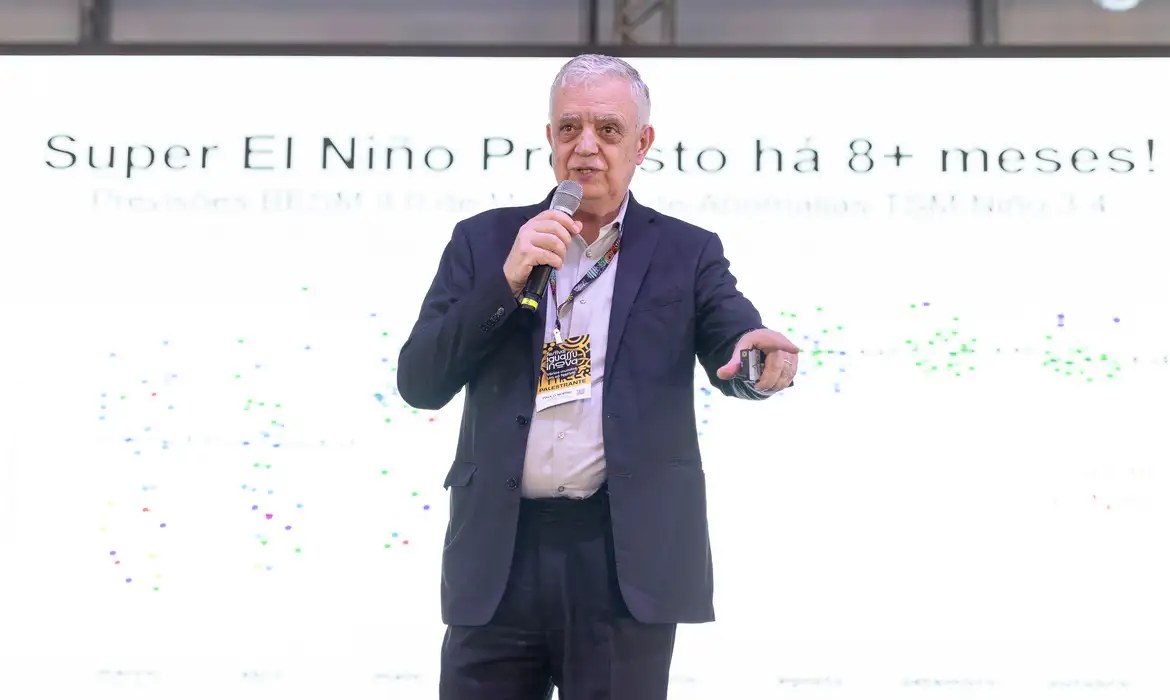
🌊 The current super El Niño, the most intense form of the warming of the equatorial Pacific, is only the beginning, according to Brazilian climate scientist Paulo Nobre. "It is not one super El Niño, it is the first of a new class of this phenomenon," the senior researcher at the National Institute for Space Research (INPE) said on the sidelines of the Iguassu Inova festival in Foz do Iguaçu, as the state news agency [Agência Brasil](https://agenciabrasil.ebc.com.br/meio-ambiente/noticia/2026-11/super-el-nino-e-o-primeiro-de-uma-serie-alerta-climatologista) reports. More such events would hit countries in the coming years, he said. 🌧️ For Brazil, Nobre expects less rain in the North and Centre-West and more in the South, but there in the form of long dry spells followed by sudden downpours. INPE had forecast this event since March, he said, and forecasts eight to ten months ahead put the onus on authorities to prepare. 🏙️ Nobre calls for cities that can cope with too much water, too little water and extreme heat, and urges people to demand this from politicians at every level of government. The figures give his point weight: according to a survey by the statistics office IBGE, only 55.4 per cent of Brazilian municipalities have a master plan, and three in four suffered environmental damage such as drought, flooding or landslides within two years.
🌡️ A record event in the background. This year's El Niño has been under way since June and has already broken several records. In early November the climate site [Carbon Brief](https://www.carbonbrief.org/simply-staggering-rapidly-developing-super-el-nino-on-track-to-peak-in-december) analysed more than 600 forecasts from 14 climate models: they expect a December peak with sea surface temperatures about 4C above average in the central Pacific Niño3.4 region, more than a degree above the previous record of 2015-16. Carbon Brief therefore projects a 2027 global average temperature of about 1.74C above pre-industrial levels and a 96 per cent chance that it will be the warmest year on record. Nobre's view that such events will become more frequent is his assessment as a researcher; he did not cite a specific study for it when talking to journalists.
🌧️ What "more rain" in the South means. Nobre warned against misreading the outlook for southern Brazil. More rainfall does not mean a little more rain every day, he said, but several dry days and then suddenly "the tap is turned on". These downpours are exactly what overwhelms cities without adequate drainage.
🌳 Trees, and cables underground. As an example of adapting to heat, Nobre pointed to cities in Paraná such as Maringá, Foz do Iguaçu and Curitiba, where street trees act as natural air conditioning. He rejected the objection that storms bring trees down onto power lines: then bury the cables, he said. People cannot simply carry on living as if nothing were happening.
📋 Where responsibility lies. Floods and landslides hit the poorest people in risk areas first, Nobre said, which some researchers and activists call environmental racism; in the end, though, everyone will be affected. Many people do not know that they may not build in certain places, and the responsibility for that lies with those who govern. Under Brazil's 2001 City Statute, a master plan is mandatory for municipalities with more than 20,000 inhabitants. According to IBGE, about 3,100 municipalities have one, and 92.2 per cent of those required to. Environmental damage within two years was reported by 4,140 of the 5,571 municipalities.
🐟 Drought with a long tail. Nobre recalled the strong El Niño of 2023 and 2024, when northern Brazil suffered a severe drought: at the headwaters of Amazon tributaries, he said, you could walk across the Rio Negro. Because the young fish that would have grown in the lakes and been caught the next year never appeared, such a drought affects fishing communities over several years. Experts also expect disruption to agriculture.
⚡ Power despite the dry spell. For hydropower in the South, Nobre sees no risk of low reservoirs, but in the North he does. He does not expect shortages for Brazil as a whole, because the country has plenty of sun and solar power is the cheapest way to generate electricity. Since solar only works by day, he argues that hydropower plants should be spared and used as storage; the mix of sun, wind and water keeps supply secure even in extreme years.
🗣️ Misinformation as the bigger enemy. Speaking to a mostly young audience, Nobre said humanity's greatest enemy is not the climate but false information, such as the narrative that the blame lies only with those who polluted during the Industrial Revolution. That may be so, he said, but the present generation bears the consequences. The Agência Brasil reporter travelled at the invitation of the organiser Itaipu Parquetec, a technology centre linked to the Itaipu hydroelectric dam.