🌏 Nine felt quakes in a month: is Australia's Top End getting shakier?
In brief
- 🌏 Northern Territory residents reported feeling nine earthquakes in 30 days, including magnitude 6.8 and 6.6 quakes in the Banda Sea.
- 🧪 Geoscience Australia seismologist Phil Cummins calls it random clustering, not a trend.
- ⚠️ A damaging quake in Darwin is rated very unlikely but cannot be ruled out.
- 🏢 Experts expect Darwin's cyclone-coded buildings to cope better than most.
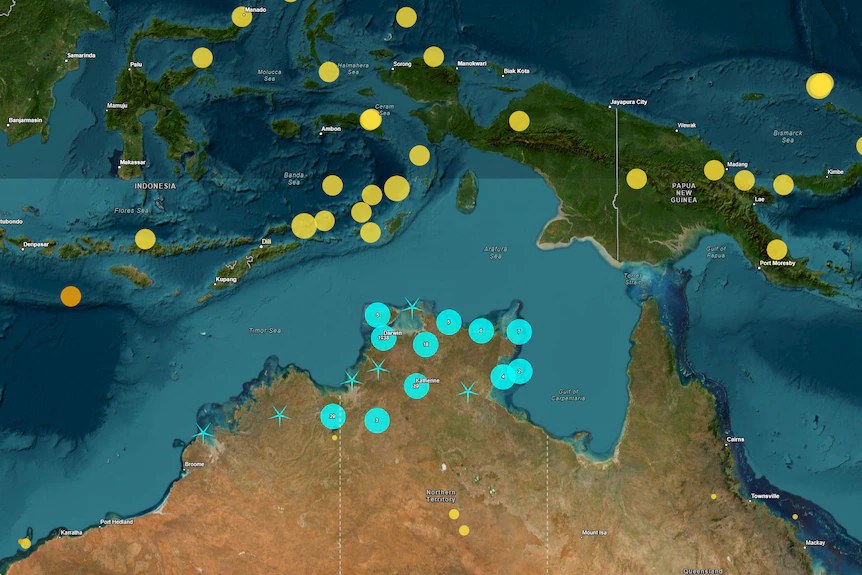
🌏 In the Top End, the northern part of Australia's Northern Territory, residents have reported feeling nine earthquakes to Geoscience Australia over the past 30 days. The strongest came from the Banda Sea in Indonesia, about 700 kilometres to the north-west: a magnitude-6.8 quake felt from Darwin to Katherine and Groote Eylandt, and days earlier a 6.6, plus several above magnitude 5. The ABC asked experts whether this is a trend. 🧪 Phil Cummins, senior seismologist at Geoscience Australia, says there is no evidence that earthquakes are becoming more frequent; the recent run is random clustering. Darwin's modelled hazard did rise sharply in the 2023 national assessment, but because of a new model of how Banda Sea shaking reaches northern Australia, not because of more quakes. ⚠️ Experts rate a damaging quake as very unlikely but not impossible. Darwin's newer buildings, built to strict codes after Cyclone Tracy in 1974, are seen as comparatively resilient; the repair bill would be the bigger shock.
🗺️ Why the Banda Sea shakes so often. In the sea north of Australia, large and small tectonic plates converge in a complex way, so earthquakes are common. Geoscience Australia explained in December 2024 that the shaking energy of these quakes travels especially efficiently to northern Australia, more so than to some places much closer to the epicentre. That is why the national seismic hazard assessment, the first update since 2018, now flags Darwin as an area with a higher risk of strong ground shaking. The point seismologist Trevor Allen made at the time still holds: Australia is not suddenly getting more or stronger earthquakes, only a better understanding of the risk.
📜 What history shows. Cummins described two scenarios to the ABC that could really harm Darwin. The first is a very large Banda Sea quake of magnitude 7, 8 or more: damage in Darwin could not be ruled out despite the hundreds of kilometres in between, but such an event comes roughly once a century or less often. The reference case is the magnitude-8.3 quake of 1963, one of the strongest ever to reach the Territory, which caused minor damage in Darwin and cut power and telephone services. Cummins considers the second scenario the more dangerous one: a magnitude 6 or 7 quake closer to Darwin, along the edge of the Australian continental shelf. No active faults are known there, he said, but the possibility cannot be dismissed.
🏗️ How Darwin's buildings would fare. Cyclone Tracy largely destroyed Darwin in 1974; strict building rules have applied since, and the city ranks among Australia's most disaster-resilient. Scott Menegon, an earthquake engineering researcher at Swinburne University of Technology, puts the difference this way: a cyclone pushes a house sideways, an earthquake shakes it from below. Because wind loads in Darwin are so high and there are few old unreinforced masonry buildings, he still expects the city to be more resilient than others. Buildings are designed for life safety: one may not collapse, yet still have to be demolished after a strong quake. Menegon therefore calls a damaging quake a low-probability, high-consequence event in which the economic cost would be the real surprise.
📡 Sensors in city towers. Menegon is part of a 300,000-dollar research project run by the National Emergency Management Agency that is installing instruments in several Darwin city buildings to record how they respond to large regional quakes. Together with data from other cities, the researchers want a national dataset that reflects local conditions. Nationally, Geoscience Australia says the hazard stays low compared with New Zealand, Indonesia or Papua New Guinea; the most vulnerable structures are older masonry buildings, for which the agency has published retrofitting guidance.