🌿 Carbon lost in Indonesia's 2026 fires may take centuries to return, analysis in The Conversation estimates
In brief
- 🌿 About 1.9 million hectares burned by late September, 38% more than in 2019, per Nusantara Atlas.
- 🌍 Estimated emissions: about 100 million tonnes of carbon, or 370 million tonnes of CO₂.
- 🪵 Peat made up 20% of the burnt area but 80% of the carbon released.
- ⏳ The authors put full peat recovery at about 400 years, even under ideal conditions.
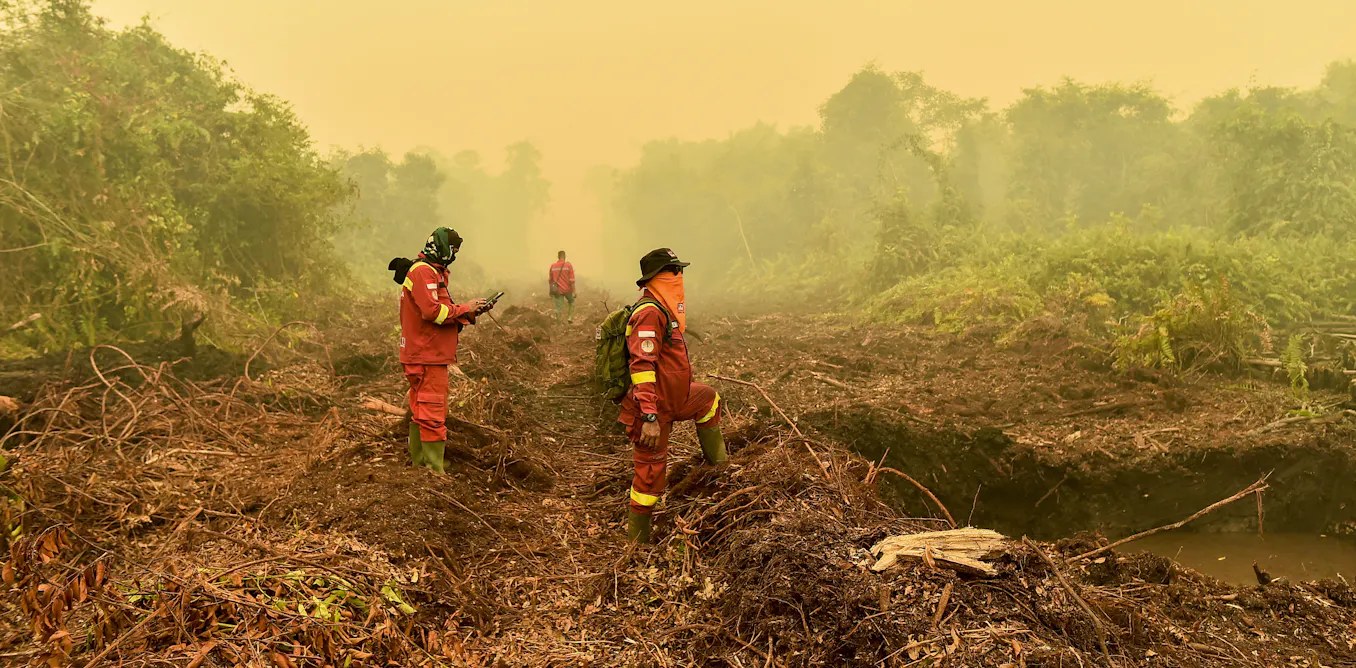
Fires burned across Indonesia through most of 2026, and researcher Budiman Minasny asks in an analysis in The Conversation how long the land will need to recover. As of late September about 1.9 million hectares had burned, according to the independent platform Nusantara Atlas, 38 percent more than in 2019, another El Niño year. The authors estimate that the fires released about 100 million tonnes of carbon, roughly 370 million tonnes of carbon dioxide and equal to the annual emissions of 97 coal-fired power plants. Peatland made up only about 20 percent of the burnt area, 400,000 hectares, but about 80 percent of the carbon released, because peat holds material built up over thousands of years that burns away in weeks or even days. 🌍 Grassland can recover within a few rainy seasons and forests need decades, but the authors estimate that peat burnt in 2026 may take about 400 years, assuming prompt rewetting and no further fires. In a scenario in which restoration keeps facing disturbances, they put the time needed to regain 90 percent of the lost carbon at about 350 years.
**Recovery by ecosystem.** The analysis sorts the burnt land by type. About 300,000 hectares of grassland burned, and grassland generally recovers in a few rainy seasons. Up to 550,000 hectares of shrubland, cropland and plantations may need a few more years to return to productivity. Around 80,000 hectares of tropical rainforest burned: the carbon stores of previously disturbed secondary forest may need 20 to 50 years to be restored, a pristine primary forest longer, and the ecology and biodiversity of forests possibly hundreds of years.
🧪 **Why peat is different.** Rewetted and replanted peatland can form only up to 0.8 tonnes of carbon per hectare each year, equal to up to 2 millimetres of new peat a year. That slow rate underlies the estimate of about 400 years for peat burnt in 2026, which, the authors stress, already assumes ideal conditions: prompt rewetting, restored vegetation and no further fires. For a restoration scenario that keeps meeting disturbances, they estimate 140 to 200 years to replace half of the lost carbon and about 350 years to restore 90 percent; the article does not explain how these scenarios relate to the 400-year figure. If degraded peat is abandoned or planted with oil palm, recovery may be impossible, they write, because drained peat keeps losing 10 to 20 tonnes of carbon per hectare every year even without fires.
📏 **Measuring the loss.** The carbon estimate uses earlier studies on land use and emission factors. Actual emissions could be higher, the authors say, because satellites cannot always detect small fires or fires under thick haze, and scientists at the Copernicus Atmosphere Monitoring Service predicted that carbon emissions from Indonesian fires could reach 200 million tonnes by October. Indonesia had much more severe peat fires in 2015, when more than 900,000 hectares of peatland burnt; the 2026 peat area is smaller, but the 2015 damage has not been repaired. Even if all peat burnt in 2015 had been rewetted a year after the fire, the carbon restored would reach only 3 percent of what was lost 11 years ago.
🚧 **Why restoration is hard.** After 2015 the government set up the Peatland Restoration Agency (BRG) to restore 2.5 million hectares of peat, mainly by blocking drainage canals to keep the ground wet. By the time it was disbanded in 2025, the agency claimed 1.6 million hectares restored outside business concessions. Yet fires broke out this year in provinces once named priority areas: South Sumatra, West Kalimantan and Central Kalimantan. The authors argue that the obstacles are not simply technical. Slash-and-burn remains the cheapest way for some communities to clear land, and in Riau province land cleared by burning sells for 1.3 times the price of land cleared by cutting. Overlapping land claims and the popularity of oil palm complicate matters, while wetland-friendly crops such as sago and jelutong lack strong markets. Their conclusion is that blocking canals and replanting trees is not enough: locals need an economic incentive to keep peat wet, or the carbon lost in 2026 becomes an environmental debt for future generations. The article first appeared in Indonesian.