💻 Inkling 2 Mini: Thinking Machines releases an open-weights model that runs on a laptop
In brief
- 💻 26.4bn parameters, about 20GB of memory, Apache 2.0 licence.
- 🔁 The middle layers run three times per token: more reasoning, less text written.
- 🧪 Leading open models under 100bn parameters on coding benchmarks is the lab's own claim.
Thinking Machines Lab, Mira Murati's startup, released Inkling 2 Mini on Friday. It has open weights, 26.4 billion parameters (3.4 billion active per token) and takes up about 20GB of memory, so it fits on a current laptop. Its trick: the middle layers run three times for every token, so the model reasons more without writing more. The lab says it leads every open-weights model under 100 billion parameters on coding benchmarks such as DeepSWE (48.2%). 🔓 The weights are on Hugging Face, Ollama runs it on Macs with at least 32GB, and the licence is Apache 2.0.
**Build.** Inkling 2 Mini is a mixture-of-experts model with 24 layers in four blocks of six. The first and last blocks run once, the two middle blocks three times; counting the loops that is 5.4 billion weight activations per token. Most weights were trained and run natively in Nvidia's 4-bit NVFP4 format, so converting later loses nothing. The lab cut two-thirds of the experts during training and then taught the model on 1 trillion tokens from a larger internal Inkling model. A version without loops cost 7.5% less to train but needed 140% more compute at run time to match the looped one.
**Numbers.** The lab reports 48.2% on DeepSWE v1.1 and 77.9% on a hard set of SWE-bench Pro tasks; Alibaba's Qwen3.8-27B scored 42.2% and 73.8%. Artificial Analysis, which tests models independently, put it at 20 on its Intelligence Index, matching Qwen3.8 27B with about five times fewer active parameters. Per task it was about six times cheaper and four times faster ($0.59 and nine minutes against $3.53 and 38.2 minutes), but used about 38% more output tokens. The context window is one million tokens.
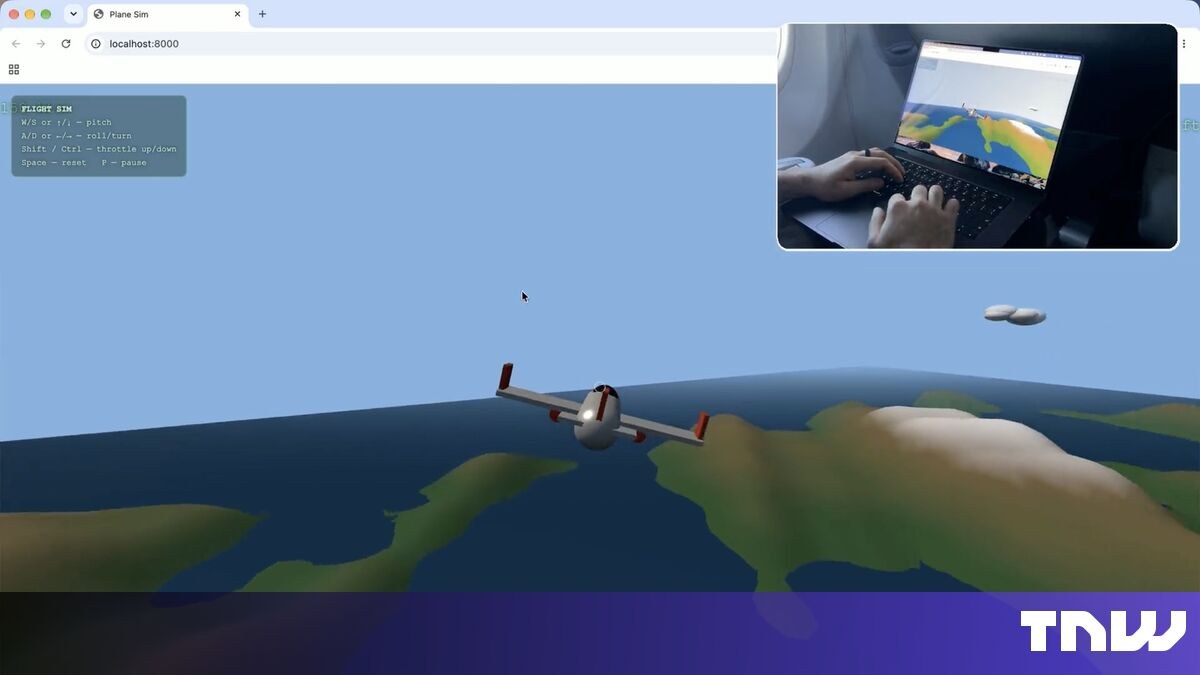
**Limits and oversight.** Qwen3.8-27B beats it at multi-turn chat and at instructions with many constraints. It trails larger models on hard reasoning, and looping does not help it store more facts. Oversight is the delicate part: labs partly check models by reading the written-out chain of thought, and a model that reasons more internally escapes that. Alongside, Thinking Machines releases a research model that can loop one to five times. Its reasoning at five loops was shorter (1,661 tokens against 3,703) yet stayed readable, and extra loops did not make it better at hiding sabotage. The lab calls the results preliminary. For the demo the team took the model on a flight: offline on a MacBook Pro, it built a playable flight simulator in a few minutes.