🏠 Landlord Licence Check: does a rental home in England need a licence? A postcode tells you
In brief
- 🏠 The website and app Landlord Licence Check tells landlords in England whether a home needs a council licence.
- 🔎 It asks only for the postcode, the number of people living there and the number of households; the answer is free.
- 📄 A dated PDF report with sources and next steps costs £4.99 once, with no account.
- 📱 On the web, the App Store and Google Play; England only, not a government service.
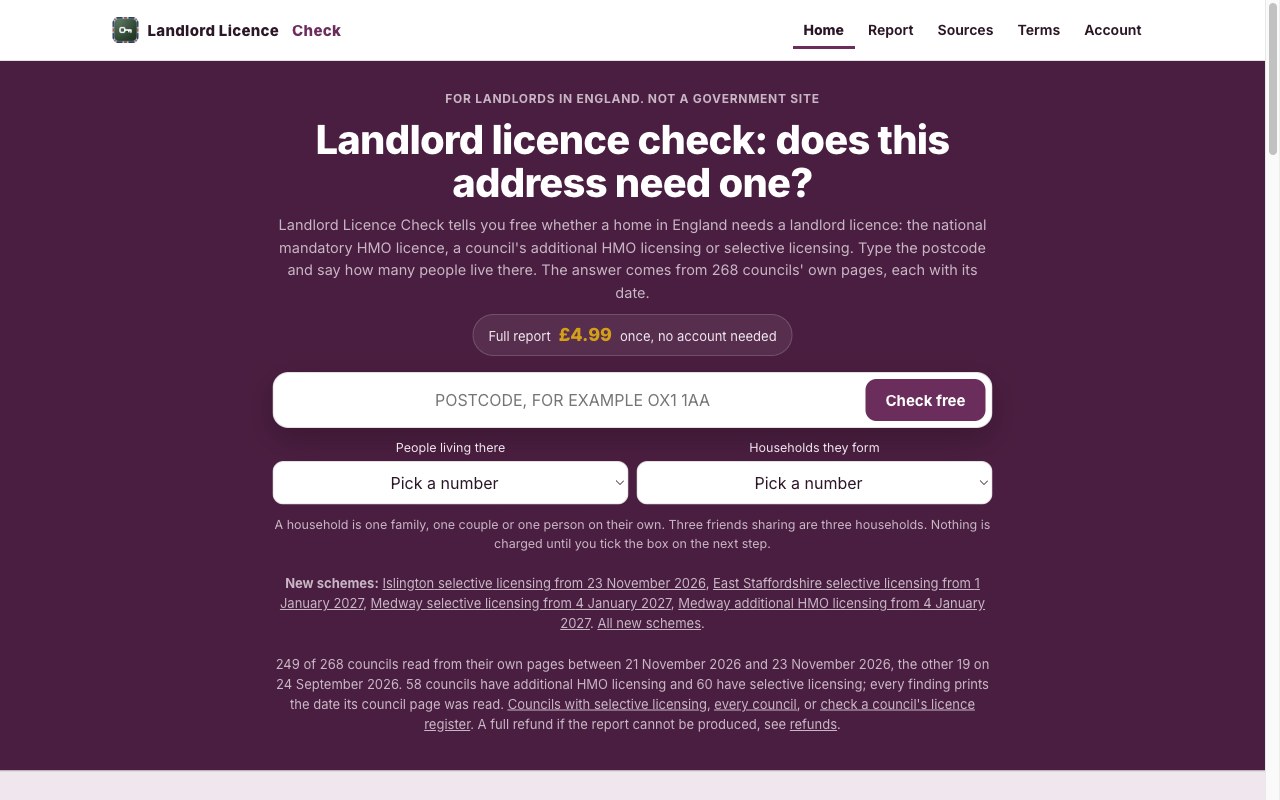
🏠 Anyone in England who lets a home to several people often needs a licence from the local council, and many small landlords do not know whether their council runs a scheme of its own. [Landlord Licence Check](https://landlordlicencecheck.co.uk) is built for that question: you enter the postcode, the number of people living there and the number of households they form. The free answer says whether the national mandatory licence for houses in multiple occupation (HMO) applies, whether the council runs additional HMO licensing or selective licensing for all rented homes, and whether an Article 4 direction covers the address, naming the law and the council scheme. 📄 A dated PDF report for one address costs £4.99 once, with no account and no subscription. According to the maker, the data comes from the pages of 268 councils, each with the date it was read. The service runs in the browser and as an app for iPhone and Android. It covers England only, is not a government service and is not legal advice; the licence itself can only be obtained from the council.
🧮 **What the check works out.** The core is the national rule: in England a house needs a mandatory licence when five or more people from at least two households live there and share a kitchen, bathroom or toilet, as the government portal [GOV.UK](https://www.gov.uk/house-in-multiple-occupation-licence) also states. A household is one family, one couple or one person on their own, so three friends sharing are three households. Councils can extend licensing to smaller shared houses (additional licensing) or require every privately rented home in a named area to be licensed (selective licensing). Whether an address lies inside such an area can depend on the ward, and that is what the tool reads out.
🗺️ **Where the data comes from.** According to the home page, the table holds the schemes of 268 of England's 296 councils; 58 of them run additional HMO licensing and 60 selective licensing. Almost all rows were read from the councils' own pages between 21 and 26 November 2026. Article 4 areas, where turning a family home into a small shared house needs planning permission first, come from the national planning data. A council that is not in the table is reported as not checked, never as having no scheme. The home page also lists new schemes, such as selective licensing in Islington from 23 November 2026 and in Medway from 4 January 2027.
📄 **What the report contains.** The paid report has eight sections, each with its source and date: the mandatory licence, additional and selective licensing, Article 4, what letting without a licence can cost, how a licence is granted and what fee the council publishes, and why a licence is not planning permission. The maker promises a full refund if a report cannot be produced and says the product stops selling reports on data older than 90 days.
⚖️ **Why landlords care.** According to the maker, letting an unlicensed HMO can bring a civil penalty of up to £40,000, and tenants can claim back up to two years of rent. GOV.UK mentions an unlimited fine on prosecution. A licence lasts at most five years and is applied for at the council, separately for each house.
🔍 **Who it suits and who it does not.** The tool is aimed at private landlords in England who let a home to several people or are thinking of buying one. Landlords in Scotland, Wales or Northern Ireland get no answer; their rules differ. The site itself points out that it is not run by any public body and that every source can be read free on council pages and GOV.UK; the £4.99 pays for finding and explaining them. The company behind it is JAGAT IT UK LTD. The code was started in September 2026, the iPhone app was approved on 18 November and the Android app has been public since 25 November. On the SideProjectors marketplace the developer is also offering the project for sale, so users should expect that the operator may change. 🏷️