📰 Gaza column: Israel's killings of security chiefs aim to sow chaos, author argues
In brief
- ✍️ Writer Iyad al-Qarra argues in an Al Jazeera column that Israel's killings of Gaza security officers are a strategy to dismantle institutions.
- 👮 Within 24 hours, he writes, the head of internal security and the official in charge of the north were killed.
- 🧩 Without police, crime, looting and clan violence grow, he warns.
- ❓ He asks whether planned security arrangements will protect Palestinians or mainly serve Israel.
✍️ In an opinion piece on Al Jazeera's Arabic site, writer Iyad al-Qarra argues that Israel's killings of security commanders in Gaza pursue far more than the stated military aims. By his account, Israel killed the director general of the internal security service, Brigadier Naim Abu Nahl, and within 24 hours the official in charge of the north of the territory, Colonel Mohammed Abu al-Awf; Israel, he writes, justified strikes on security figures by their activity against it. Our research found no independent confirmation of these two cases; similar strikes on security officers in July are documented. 🧩 Al-Qarra's thesis: the strikes now reach the second and third levels of leadership and with them experience built up over decades. Together with support for armed anti-Hamas groups and stalled reconstruction, he argues, they use chaos as a tool to lock in the results of the war and impose Israel's terms on Gaza's future. ❓ He points to the contradiction that a new police force, a Palestinian administrative committee and the role of the Board of Peace are being discussed at the same time. The piece is the author's opinion; Al Jazeera notes that it does not necessarily reflect the network's editorial position.
📜 **From leaders to institutions.** Al-Qarra notes that targeted killings are not a new policy: in 2003 and 2004 Israel killed Hamas founder Ahmed Yassin and his successor Abdel Aziz al-Rantisi. What is new, he says, is that the strikes now go beyond political and military leaders to administration, security and civil and community work. Citing figures from Gaza's government media office from March 2026, he writes that more than 2,800 police and security personnel have been killed since 7 October 2023; Reuters, he adds, put the police force at around 10,000. According to him, the UN human rights office documented in an August 2026 report at least 18 Israeli attacks on Palestinian police since the start of the year, killing 57 officers, some while carrying out ordinary civilian tasks.
🏛️ **Three systems in the crosshairs.** The author distinguishes three areas: civil administration, with ministries, municipalities, health, education and relief; community security through the police and interior ministry, which fight crime, regulate markets, settle family disputes and secure aid; and the security and intelligence apparatus, including bodies of Hamas itself. Israel, he writes, treats the mere continuation of civil services as a sign that Hamas is rebuilding. Al-Qarra calls this a confusion of political affiliation, civil function and military activity: many municipalities are run by professionals, and serving the population is no proof of military activity.
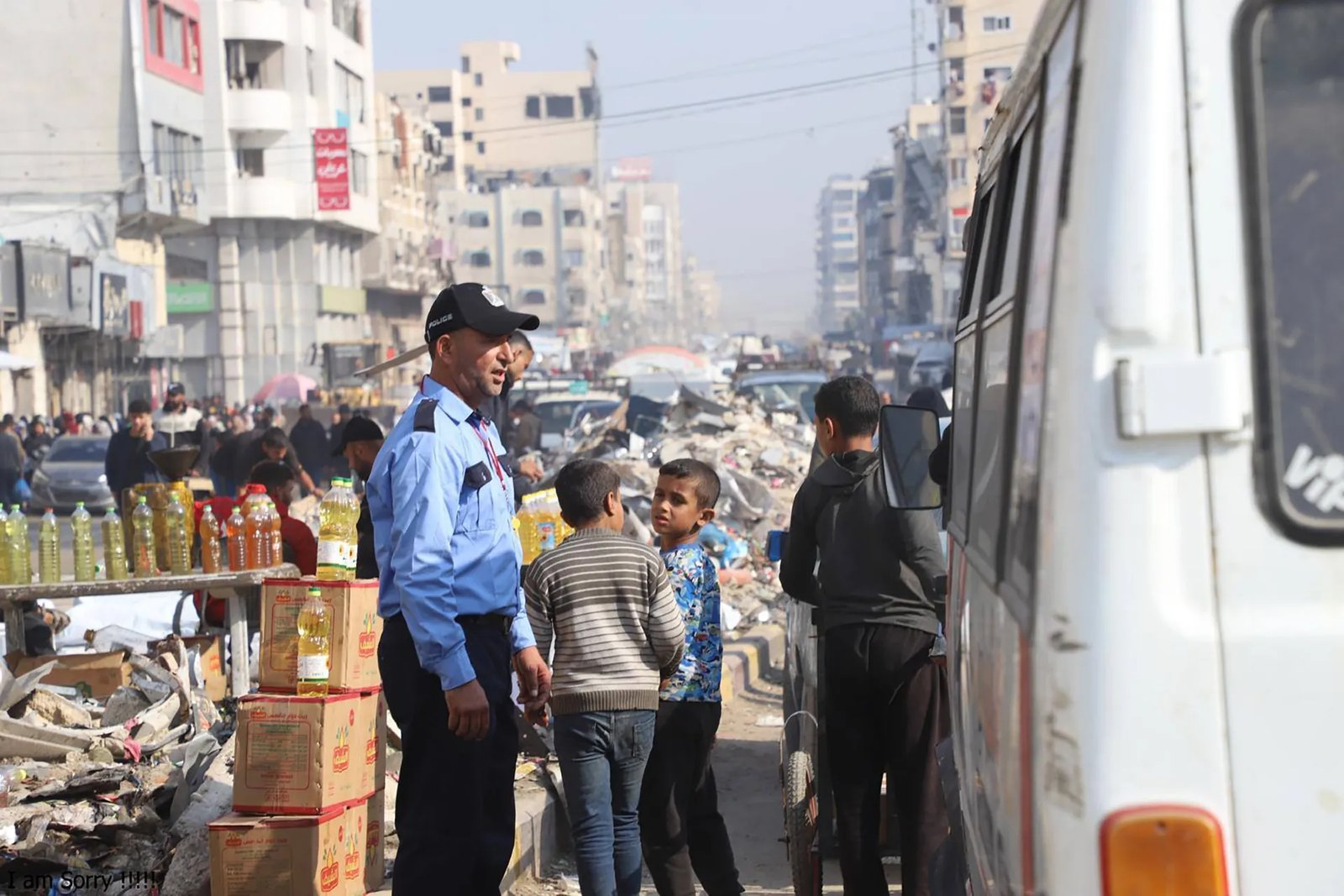
👮 **Why policing matters now.** War, repeated displacement, poverty and lost incomes have, in the author's words, created an extremely fragile society in which family feuds, property crime and lawlessness grow. When police and courts are weakened, force and clan influence rule; when officers guarding aid convoys are hit, the risk of looting rises. Then there is the intelligence war: he fears that Israel seized large amounts of data during ground operations and arrests, and that it exploits people's hardship to recruit informants and to blackmail.
🔫 **Militias as a second track.** As evidence of a parallel strategy, al-Qarra cites Prime Minister Benjamin Netanyahu's admission on 5 June 2025 that Israel supports armed anti-Hamas groups to reduce risks to its soldiers. Among them he names the so-called Popular Forces led by Yasser Abu Shabab in the Israeli-controlled south, which were accused of looting aid, a charge the group denies. To him, killing security officers and backing militias are two sides of one approach: one drains existing institutions, the other builds power outside the law. The model, he argues, resembles the West Bank: Israel keeps a free hand for raids and control without taking responsibility for administration and services, and growing chaos could then justify delaying a withdrawal.
⚖️ **Law and contradiction.** Political affiliation alone does not remove the protection international humanitarian law grants civilian police officers, the author argues. He asks about the responsibility of the Board of Peace and of the guarantors of the October 2025 ceasefire when the Palestinian administration is not empowered and security arrangements come before humanitarian needs. His conclusion: if the war destroyed the buildings, chaos threatens society's ability to rebuild them; there is no reconstruction without security and no security without institutions.
📝 **How to read it.** Al-Qarra writes from a Palestinian perspective; Israel justifies such strikes by saying those killed belonged to Hamas or acted against Israel. As Al Jazeera reported in July, an Israeli air strike in Deir al-Balah killed Colonel Wael al-Ladawi, head of the internal security service in central Gaza; Hamas then also spoke of a strategy to sow chaos. The recent cases and figures the author names are his own account.