💾 Same hard drive, more than double the price: Alex Kretzschmar does the Black Friday maths
In brief
- 💾 Self-hoster Alex Kretzschmar paid $249.99 for a 20 TB WD EasyStore in 2024; on Black Friday 2026 the same model at the same store costs $549.99.
- 📈 Recertified enterprise drives in his table cost 58 to 218 percent more per terabyte than in 2024.
- 🏭 He blames a market left with three makers and calls it a cartel; that is his opinion, not an established finding.
- 🗄️ His conclusion: make do with fewer drives.
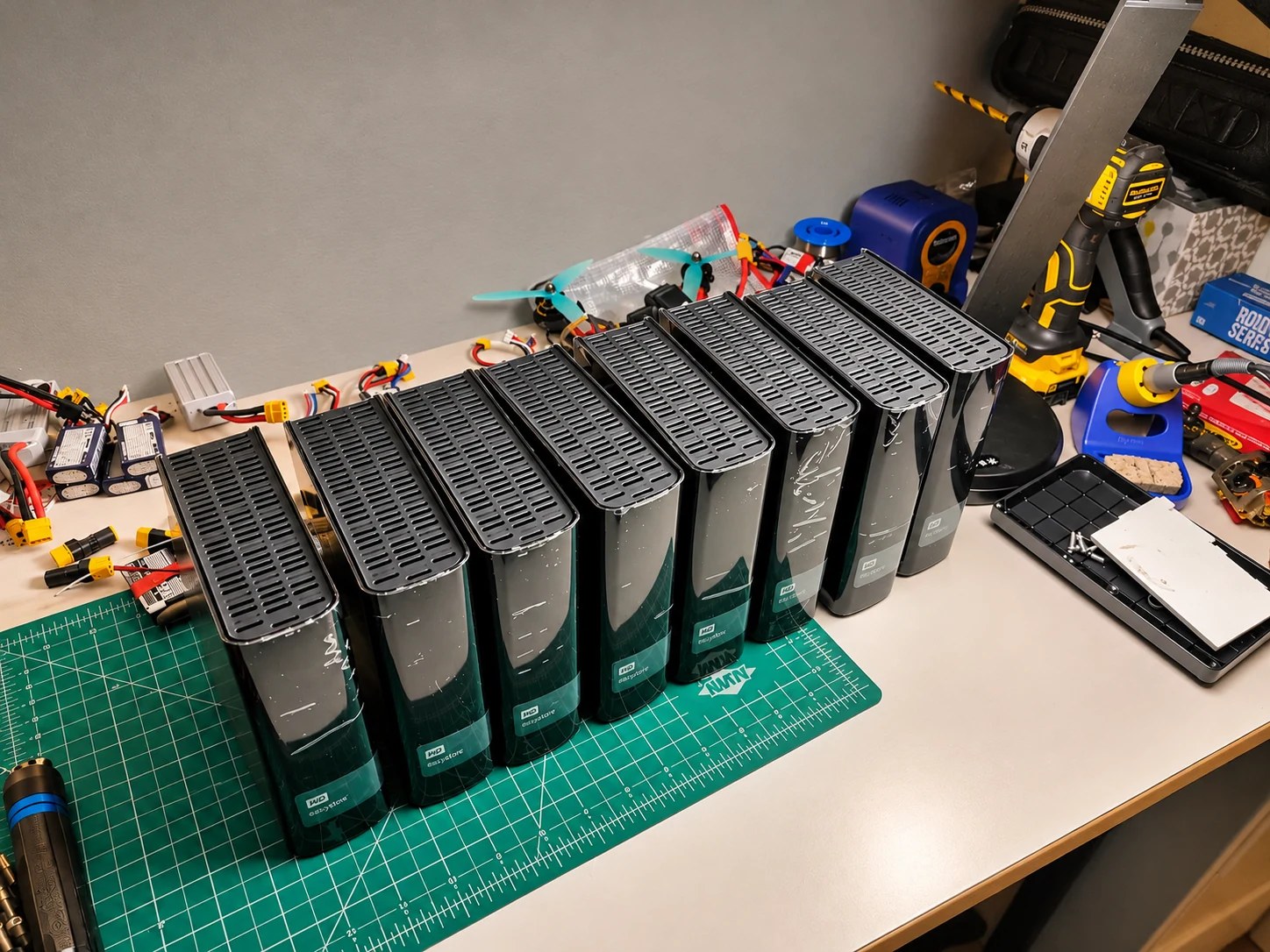
💾 For years Alex Kretzschmar has replaced one or two hard drives in his home server every Black Friday. This year he is holding back: the 20 TB WD EasyStore external drive he bought at Best Buy for $249.99 in November 2024 is on Black Friday sale there for $549.99, 2.2 times as much. That is $27.50 per terabyte instead of $12.50. 📈 In a blog post dated 26 November he compares eight years of his own purchases and four recertified enterprise drives whose price per terabyte has risen 58 to 218 percent since 2024. A complete NAS with four 20 TB drives would now cost about $2,200 instead of $1,000. 🏭 His argument: after years of takeovers only Seagate, Western Digital and Toshiba are left, and home buyers barely matter to them. He reads the situation as collusion by a manufacturers' cartel; he offers no evidence of a current price-fixing agreement, so this is his view. The makers themselves said early in 2026 that their output was sold to large cloud customers.
🧾 **The receipts.** Kretzschmar runs about ten disks and swaps one or two a year so that none is older than five years. His purchase history now reads like another era: in November 2018 he bought five 10 TB EasyStores at $179.99 each; in October 2023 three 18 TB drives, 54 terabytes in all, for $599.97. This year's 20 TB deal alone is only $50 short of that entire order. In May 2025 he had bought the same model for $270 less. Going smaller does not help: Best Buy's 8 TB Black Friday special is $299.99, or $37.50 per terabyte.
🔧 **Why shucking no longer pays.** Home-lab users often take external USB drives out of their enclosures and put the SATA disk inside straight into a server, because the external models used to be cheaper than bare internal drives. At $12.50 per terabyte that was a cheap way to get a lot of storage, Kretzschmar writes; at $27.50 it is not.
♻️ **The second-hand route got dearer too.** Recertified enterprise drives were the other way to save: in August 2024 he bought four recertified 14 TB Ultrastars for $529.96, $9.46 per terabyte. His table compares four such models with the listings of 26 November 2026: a 14 TB WD Ultrastar HC530 (4Kn) went from $9.29 to $14.64 per terabyte (up 58 percent), the 512e variant from $9.64 to $30.64 (up 218 percent), a 20 TB Seagate Exos X20 from $11.80 to $29.45 (up 150 percent) and an Exos X22 from $11.25 to $32.45 (up 188 percent). Three of the four were also sold out.
🏭 **Three makers left.** Kretzschmar does not blame the retailer but looks at who makes the drives. He traces the consolidation: Maxtor bought Quantum's hard drive business in 2001 and Seagate bought Maxtor in 2006; Hitachi merged IBM's disk business with its own into HGST in 2003; Toshiba bought Fujitsu's unit in 2009; Seagate took over Samsung's hard drive business in late 2011 and Western Digital bought HGST in March 2012, with the US Federal Trade Commission requiring WD to sell desktop-drive manufacturing assets to Toshiba. The 2011 Thailand floods hit in the middle of these deals, and WD's annual report shows its average selling price rising from $45 to $62. He also recalls a case further up the supply chain: the supplier NHK Spring pleaded guilty in 2019 to fixing prices for the suspension assemblies that hold the read/write heads and paid a $28.5 million fine.
⚖️ **His verdict.** The market is as concentrated as the memory chip market, Kretzschmar writes, and he finds it hard to see the prices as anything but collusion by a manufacturers' cartel. That is his opinion; he cites no evidence of a current price-fixing agreement for hard drives. His second point: in fiscal 2026, 89 percent of Western Digital's revenue came from its cloud business. People buying a couple of drives for a home server have little weight there, and as with Nvidia and Micron, he says, consumers get the crumbs.
☁️ **What the makers say.** Western Digital and Seagate gave a different explanation on their earnings calls early in 2026, as The Register reported: WD chief executive Tiang Yew Tan said the company was pretty much sold out for calendar 2026, with firm orders from its seven largest customers and long-term agreements running into 2027 and 2028. Seagate chief executive Dave Mosley said its high-capacity data-centre output was fully allocated for 2026. Analysts at the time expected little production to be left for smaller buyers, with cloud and AI data centres taking most of it.
🗄️ **What he will do.** Kretzschmar is considering going from ten disks to five 20 TB drives, even though that means rebuilding his ZFS pools and moving data around. Four 20 TB drives for a NAS would have cost him $999.96 at his 2024 price and $2,199.96 this week, and setting one aside for parity makes the price per usable terabyte worse still. His wish for 2027 is a return to reasonable hardware prices; he fears it will take longer, and that making do with less will be normal for a while.