🇧🇷 Brazilian families spend more on food and health care, IBGE's big household budget survey shows
In brief
- 🛒 Food now takes 14% of household spending, up from 13.1% in the 2017-2018 survey.
- 💊 Health care rose from 8% to 9.6%, the biggest increase; IBGE cites an ageing population as one reason.
- 🏠 Housing remains the largest item but fell from 27.9% to 24.9%.
- 💶 The average family spends R$ 7,977.43 a month; poorer families spend almost three times the share on food.
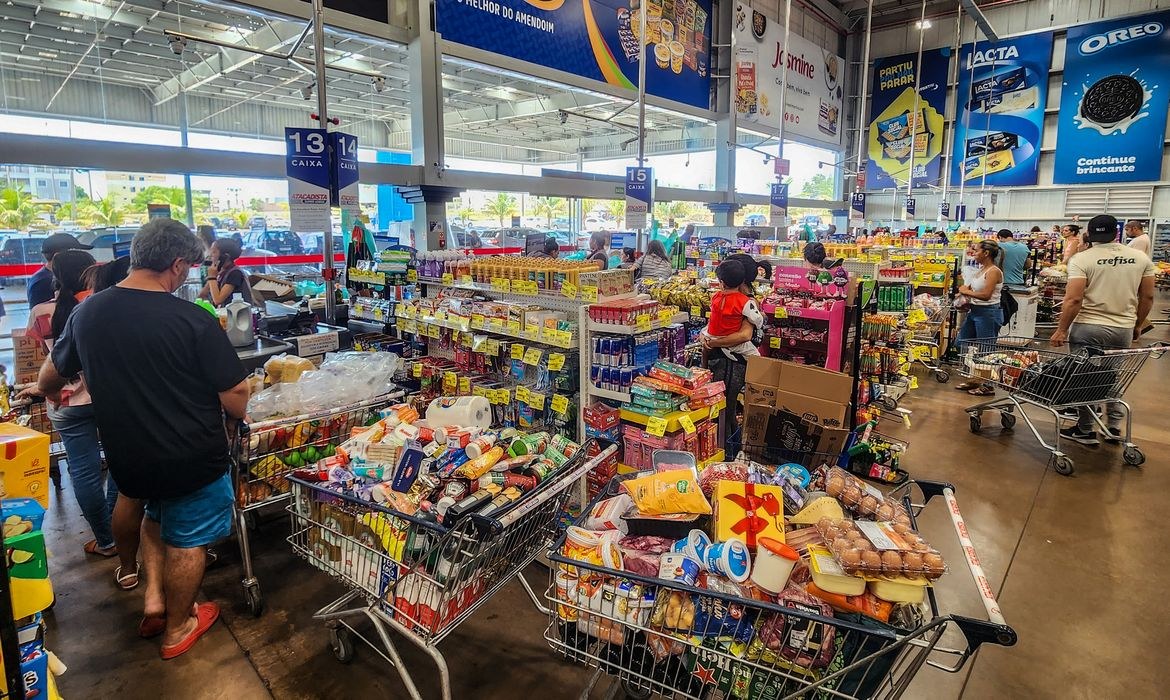
Brazilian families are putting a growing share of their budgets into food and health care. That is the finding of the household budget survey POF 2024-2025, released by the statistics institute IBGE on Friday, 27 November, the first since 2017-2018. 🇧🇷 Food now accounts for 14% of all spending and has become the second-largest consumption item after housing; before, at 13.1%, it ranked third. Health care grew the most, from 8% to 9.6%. Housing is still the biggest block, but its share fell from 27.9% to 24.9%, and transport lost weight as well. 💊 On average a family spends R$ 7,977.43 a month, R$ 1,113 of it on food. How heavily basic needs weigh depends strongly on income: families earning up to two minimum wages spend 20.9% on food, families with more than 25 minimum wages only 8.1%.
👵 **Why health costs more.** On average R$ 765.71 a month goes to health care. IBGE researcher Isabel Cristina Santos points to the demographic transition of the past ten years: the population is ageing, life expectancy is rising, and older people develop more chronic illnesses, need more medicine and see doctors more often.
🏠 **Housing and food: the burden on poorer families.** IBGE counts not only rent as housing but also electricity, water and gas, researcher Luciana Santos explains. For families with up to two minimum wages housing takes 36.2% of the budget, for those above 25 minimum wages 19.1%. Together, food and housing absorb 57.1% of spending among the poorest and 27.2% among the richest. People with low incomes have to eat and need a place to live, IBGE researcher André Luiz Costa says, so a tight budget is filled with these basic needs first.
🚌 **Transport, education, the rest.** Transport's share fell from 14% to 13.2%; it weighs more for the highest earners (13.7%) than for the poorest (8.7%). Nationally families spend R$ 1,053.56 a month on transport on average, according to the news site g1. In the state of Paraná transport spending, at R$ 1,243.86, even exceeds food (R$ 1,153.49), driven mainly by vehicle purchases. Education fell from 7.4% to 7%, and other consumption such as clothing, leisure and culture from 11.8% to 10.3%.
📊 **Where the money goes overall.** 79% of the budget goes to consumption. 12.9% goes to other current expenses such as taxes and bank fees, 3.5% to building assets such as property and investments, and 4.6% to paying off debt. Families pay 78.3% of their spending themselves; 21.7% is non-monetary, for example own production, barter, gifts or free public services.
🗺️ **Large regional gaps.** Families in the South (R$ 9,133.28) and the Southeast (R$ 9,102.86) spend the most, followed by the Centre-West (R$ 8,945.45) and the North (R$ 6,835.30). The Northeast trails far behind at R$ 5,465.22. Urban households spend R$ 8,402.01 on average, rural ones R$ 4,886.31. On food, families in the Northeast spend R$ 862.96 a month, those in the South R$ 1,289.62.