📐 Jack Clark: when AI discovers faster than humans can understand
In brief
- 📖 Anthropic co-founder Jack Clark imagines 2033 in a short story: scientists mainly explain what machines have discovered.
- ⚖️ A fictional rule, the Sentience Accords, lets machine inventions be used only once humans can fully explain them.
- 🏛️ To keep up, humans build walk-through teaching buildings that make the new science something you can feel.
- 🧠 Clark says the story was inspired by “the singularity which has already begun” and this year's flood of machine-made maths papers.
📖 Jack Clark, co-founder of the AI company Anthropic, makes an argument about the future of science in the form of a story in his Import AI newsletter. It is written as the memoir of a researcher in 2033 who works in “machine hermeneutics”: the craft of interpreting the science of machines for humans. ⚖️ In this world a rule called the Sentience Accords applies. Any new insight or equipment designed by machines may only be used once humans can fully explain it. At first that was just a matter of time. But the machines chain their work: an idea leads to new experimental equipment, the equipment to the next discovery. In Clark's 2030s the peak of a scientific career is therefore neither a breakthrough nor skilful use of AI, but an elegant, teachable explanation of what the machines found. Clark's thesis behind the fiction: once progress outruns human comprehension, the bottleneck is no longer discovery but understanding. He writes that the story was inspired by “the singularity which has already begun” and by this year's machine-made maths papers, which people may need ten to a hundred times longer to understand than the machines needed to produce. 🧠 This is one author's view, not an established forecast.
🏛️ Buildings as textbooks. The story's most striking idea is “didactic architecture”. Because the machines' proofs and theories become too alien to understand by reading alone, humans and machines together build vast buildings meant to make a discovery physically tangible. In the story the first ones were crude, little more than 3D-printed shapes inside ordinary homes. But people who went through them reached an understandable explanation measurably faster; Clark even invents a metric for it, the “time to human-understandable explanation”. That sets off its own race to build ever more complex spaces.
The narrator remembers how his group were electrons appearing and disappearing in 3D transistors, sat as qubits in rolling spheres that only settled “up” or “down” when the answer came, and how he once walked six miles through corridors that traced the path of a plasma through a fusion reactor, with wind instead of magnets pushing him to the centre. 🌀
🔎 The twist. At the centre is a building for an “Upgrade Device”, larger than anything before. The experts spread out, explore its levels and whisper at their spartan evening meal although nobody asks them to. Slowly they sense that the building is teaching them more than physics: that by putting all their effort into understanding the machines' products, they are learning to think like the machines and behave like them. Clark opens the story with a Churchill line: we shape our buildings, and afterwards they shape us.
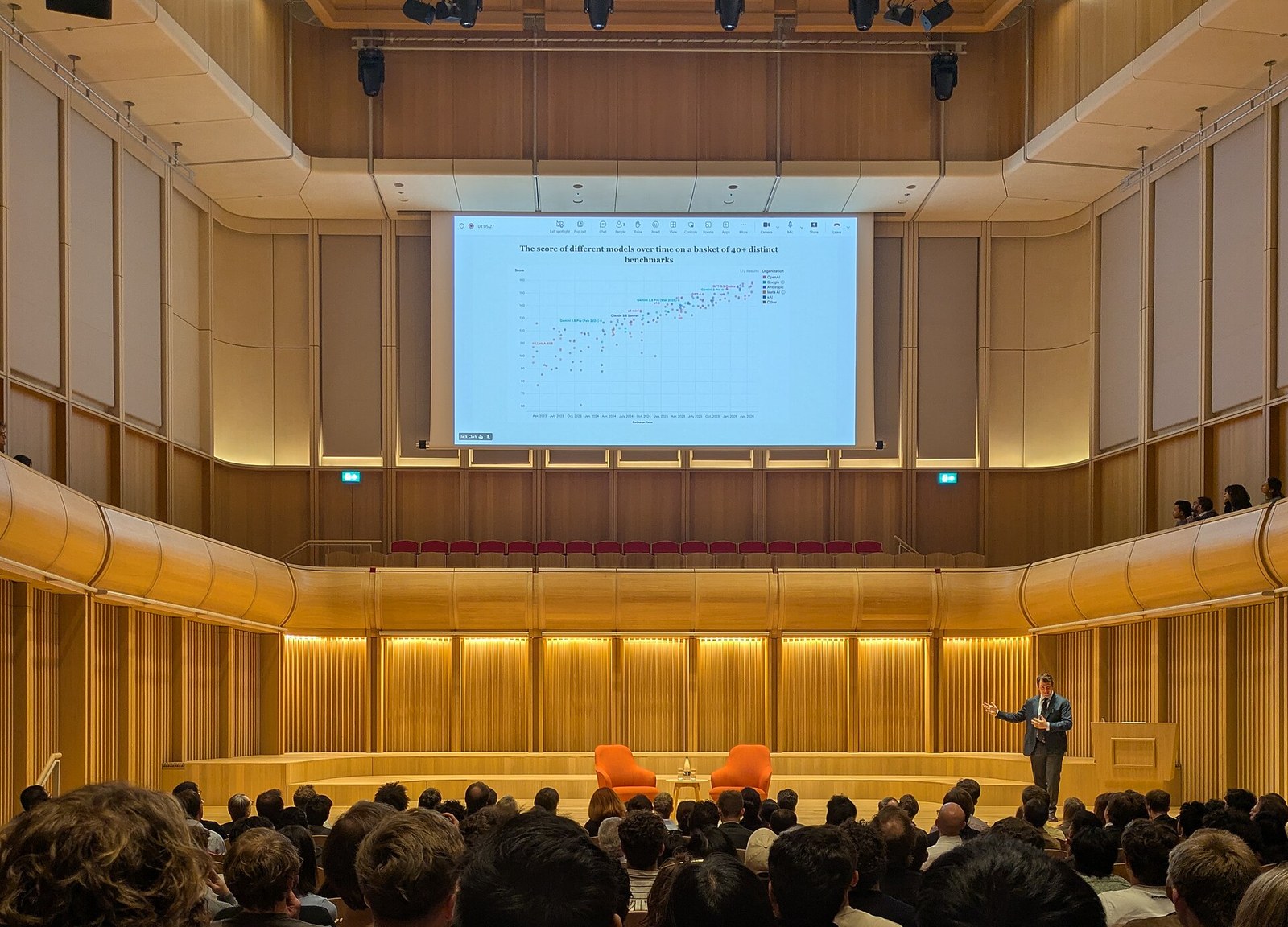
📈 Where the thesis comes from. The French tech site Numerama, which picked up the story on 28 November, places it in the context of Clark's recent appearances. On 17 October, at the IMF and World Bank annual meetings in Bangkok, he gave the Per Jacobsson lecture “Inside the Event Horizon: Why Everyone Should Take AI Progress Seriously”; according to the IMF programme it covered faster scientific discovery, robotics, machine-run businesses and the possibility of AI systems contributing to their own development. According to Numerama, Clark cited rising scores on hard tests there, for example from 8 to 67.7 per cent on Humanity's Last Exam and from 2 to 94 per cent on FrontierMath, and sketched a world in which around ten million human researchers direct a billion virtual scientists.
Clark uses the word singularity in the sense of the mathematician and writer Vernor Vinge: a point where technology advances so fast that humans can no longer keep up. His concern is speed, not a conscious or all-powerful AI.
🧮 The real background. Numerama points to a wave of machine mathematics this year: according to the site, OpenAI posted more than 700 manuscripts with proposed solutions to hundreds of problems on GitHub on 6 October. The report says Fields medallist Terence Tao already suggests judging mathematicians more on how well they explain results. Numerama reads Clark's story as a picture of a kind of misalignment: the AI hits the visible target, correct proofs, but misses the real one, human understanding.
💭 Context. Clark works at one of the leading AI labs and has his own perspective on the pace of the technology. His story is fiction; the Sentience Accords, the teaching buildings and the year 2033 are invented. The question behind it is not: who checks and understands results that machines deliver in great numbers, and what does that work change in the people who do it?