🦔 Mexican hairy dwarf porcupines glow blue, green and yellow under UV light
In brief
- 🦔 Researchers in Mexico found that live Mexican hairy dwarf porcupines glow blue, green and yellow under UV light.
- 🔬 All 20 animals examined showed this photoluminescence, most strongly on the head.
- 🏛️ Museum specimens, by contrast, glowed only faintly.
- 🔦 UV lamps made the nocturnal animals easier to find in the wild; why they glow is unknown.
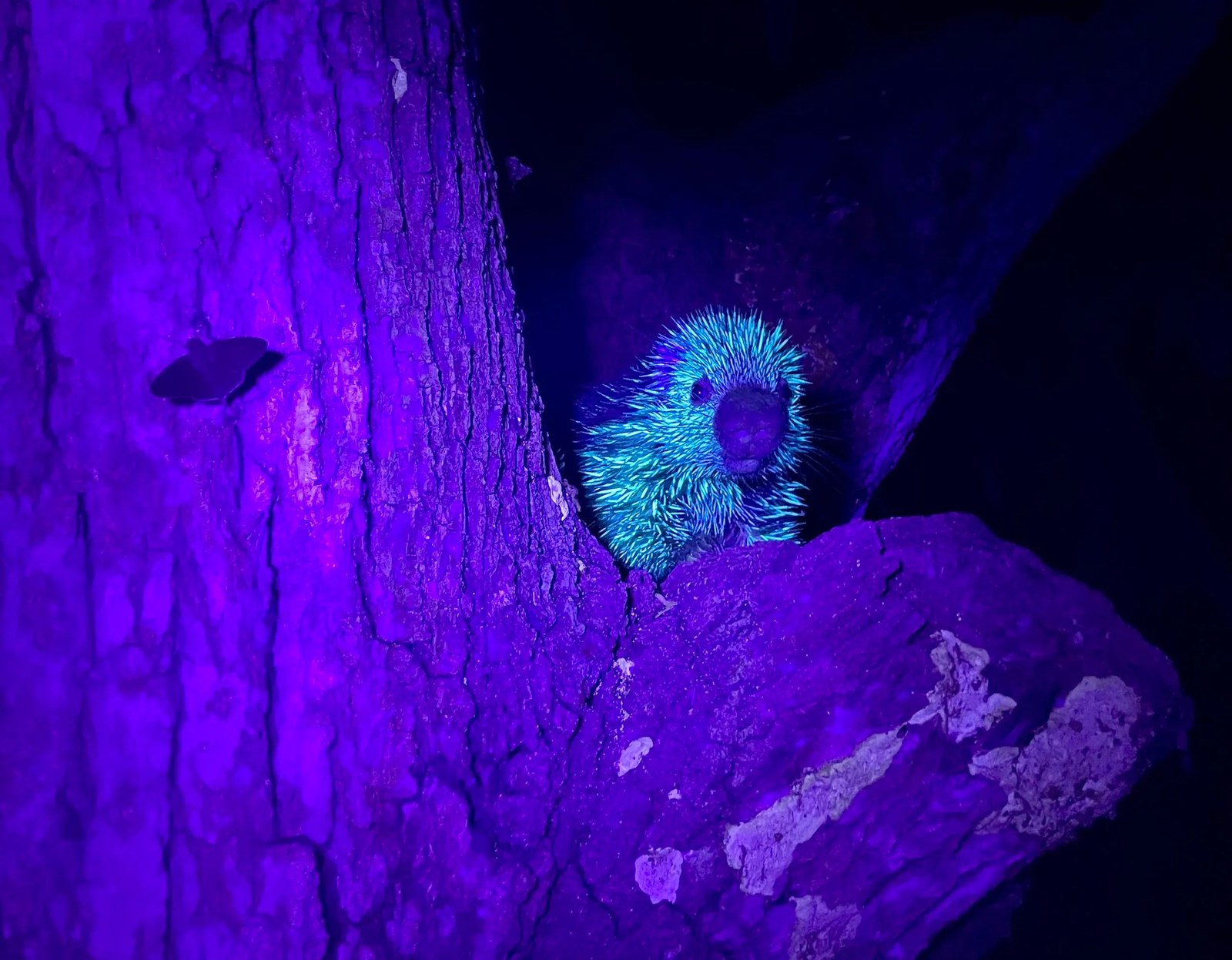
🦔 The Mexican hairy dwarf porcupine (Coendou mexicanus), a small, nocturnal, tree-dwelling rodent, glows in several colours under ultraviolet light. Researchers at the Mexican research centre [El Colegio de la Frontera Sur (ECOSUR)](https://www.ecosur.mx/) in Chetumal report this in the journal [Neotropical Biology and Conservation](https://neotropical.pensoft.net/article/210650/). Under a UV flashlight the animals' quills shone green and blue and the soles of their feet bright yellow. 🔬 All 20 live animals examined showed the effect, in which tissue absorbs short-wavelength light and re-emits it at longer wavelengths. Such photoluminescence has been described in a growing number of mammals, but mostly in museum specimens. According to the authors it is the first record for this species, alive or dead. What role the glow plays for the animals is unknown.
🏥 Found during rescue work. Since 2023 ECOSUR has helped the environmental authorities of the state of Quintana Roo and the federal environmental protection agency PROFEPA rescue and clinically examine porcupines living in the city of Chetumal. In June 2024 senior author Jonathan Pérez-Flores first noticed the glow while examining two females with a portable 395-nanometre UV flashlight, the science publisher [Pensoft](https://blog.pensoft.net/2026/11/25/mexican-hairy-dwarf-porcupines-glow-under-uv-light/) reports.
🔍 What the researchers saw. Over the next three months the team examined 20 adult animals, 17 females and three males, under veterinary supervision and with permission from the authorities; the porcupines were immobilised with ketamine and xylazine. The head glowed most strongly, greenish-blue, as did the back, legs and tail. Freshly collected quills glowed green in the section that looks yellow in daylight, with blue at their brown tips. Hairless areas appeared purple, and the palms and soles bright yellow.
🏛️ Museum versus wild. Two museum specimens, preserved more than a decade ago without fluorescent chemicals, showed only a barely perceptible greenish glow. The authors suggest that keratin, the main component of quills, degrades over time and that light exposure bleaches the effect further. Their conclusion: live and preserved animals can give different results, and both should be examined.
🔦 A cheap tool for counting. Between July and December 2024 the researchers walked a one-kilometre route on ECOSUR's grounds 12 times at night, with ten observation points and a 15-minute search at each. They recorded 20 detections, an average of 1.6 per walk, with quills and feet standing out clearly against leaves and bark. Because the animals are hard to spot in the canopy at night, UV lamps could help collect population data that barely exists. The species is listed as Least Concern by the IUCN but as threatened in Mexico.
❓ Open questions. That the glow might help porcupines perceive one another at night is the authors' suggestion; they recommend studying UV-sensitive pigments in the species' eyes. For future field work they advise comparing 365 and 395 nanometre light, because some organisms glow differently under each wavelength.