🌏 Internet cable turned earthquake sensor maps New Zealand's Alpine Fault in record detail
In brief
- 🔬 Researchers turned 30 km of unused fibre along the Haast Pass into thousands of sensing points 4 metres apart.
- 🪨 The Alpine Fault is a roughly 200 m wide zone with up to six narrow slip cores, each about 10 m across.
- 📏 The main core runs unbroken for about 180 km, including across a bend where past quakes stopped.
- ⚠️ Scientists put the chance of a magnitude 7 or larger quake within 50 years at 75 %.
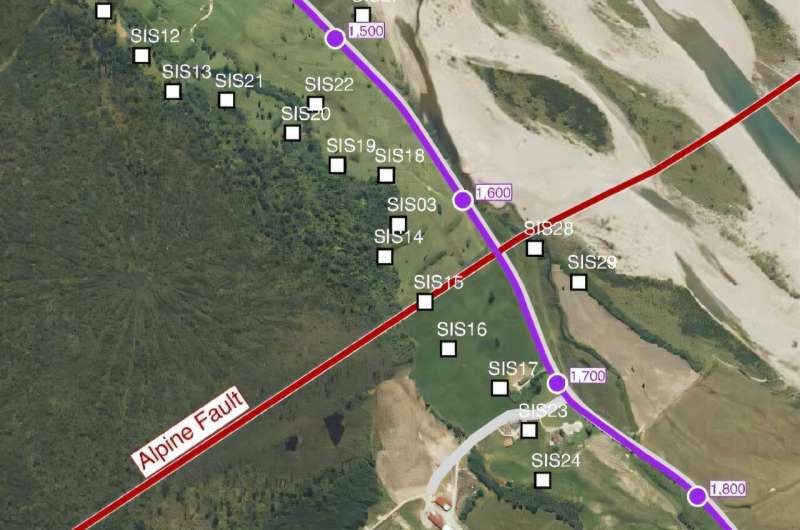
🌏 An international team has turned an ordinary internet cable in New Zealand into a dense network of earthquake sensors and used it to image the Alpine Fault in more detail than anyone before. The study, led by Lai Voon Hui of Nanyang Technological University in Singapore, is published in the journal Science Advances; the Australian National University, Victoria University of Wellington, the Chinese Academy of Sciences and network operator Chorus also took part. 🔬 The researchers sent laser pulses down an unused strand of a 30-kilometre cable along the Haast Pass highway. When seismic waves stretch and compress the glass by tiny amounts, that can be measured: the cable became thousands of virtual sensors spaced 4 metres apart. 🪨 The result: the fault is not a single crack but a zone of shattered rock about 200 metres wide holding up to six narrow slip cores. The main core runs without a break for about 180 kilometres, including across a bend at the Martyr River where earlier quakes sometimes stopped and sometimes broke through. That does not change the expected timing of the next big quake, but it supports planning for a scenario in which two segments rupture together.
⚠️ **Why this fault matters.** The Alpine Fault runs along almost the whole of New Zealand's South Island and marks the boundary between the Australian and Pacific plates. Its last major earthquake was in 1717. Geoscientists put the probability of a magnitude 7 or larger rupture in the next 50 years at 75 percent. According to the Australian National University, quakes of magnitude 7.5 to 8 occur there on average every 260 years. What happens deep inside the fault was hard to see with conventional seismometers, which often stand tens of kilometres apart.
💡 **How the measurement works.** The method is called distributed acoustic sensing. A device at the end of the cable fires laser pulses into the fibre and measures tiny reflections that change when ground waves deform the glass. Recording ran in two campaigns in 2023, 140 days in all. The cable picked up the background hum of traffic and ocean swell and 67 local earthquakes. Internet traffic carried on undisturbed, because only a spare strand was used and no customer data was touched.
🌊 **Trapped waves as a tool.** In 16 of the quakes the researchers found so-called fault-zone guided waves: energy that stays trapped in the fractured rock of the fault and travels along it. "Seismic waves trapped inside a fault behave a little like light traveling along an optical fiber," Lai said in NTU's announcement. Computer simulations matched to these waves let the team pick out individual strands only about 10 metres wide, something a conventional seismometer network cannot resolve, according to Lai.
📏 **What the continuous structure means.** The Martyr River bend divides the Central Westland and South Westland segments. In prehistoric times earthquakes sometimes ended there and sometimes ran through. The authors see the continuous main core at earthquake depth as direct seismological evidence that the two segments are connected. Supporting models, the announcement says, estimate an 82 percent likelihood of a joint rupture of both segments exceeding magnitude 8.
🔌 **Beyond New Zealand.** The experiment began in 2023 as a collaboration of ANU and Victoria University of Wellington; geophysicist Meghan Miller then spoke of a data stream of about a gigabyte per minute. Lai sees a global opportunity: fibre-optic cables already cross active faults and run through large cities. Instead of building expensive sensor networks from scratch, spare fibres could become permanent observatories for hazard assessment and early warning. Earthquakes still cannot be predicted this way, the team stressed back in 2023, but people can be better prepared.