🫀 Why the heart cannot repair itself: study points to the heartbeat
In brief
- 🔬 A team led by Spain's CNIC reports in Nature Cardiovascular Research that constant contraction stops heart muscle cells from dividing.
- ⏸️ When beating was paused in the lab, the cells dismantled their contractile machinery and divided again; when it resumed, the block returned.
- ⚡ A switch in the cells' energy metabolism goes along with it.
- 🏥 There is no therapy yet, but the mechanism is a possible target after heart attacks and in heart failure.
🫀 Skin and liver replace damaged cells with ease; the adult heart hardly does, and a heart attack leaves a scar. An international study led by the Centro Nacional de Investigaciones Cardiovasculares Carlos III (CNIC) in Madrid, published on 27 November 2026 in Nature Cardiovascular Research, offers an explanation. The heart, it finds, is caught in a basic trade-off. Its muscle cells, the cardiomyocytes, must contract more than 100,000 times a day, and that very work suppresses their ability to divide. 🔬 When the researchers temporarily stopped contraction, the cells took apart their contractile structures and re-entered the cell cycle. When beating resumed, the process reversed. The cells' energy metabolism switched along with it. The heart's poor self-repair would then be no fixed trait but a state that contraction actively maintains. Nothing changes for patients yet: the results come from lab and animal models. The authors see a new starting point for future treatments after a heart attack or in heart failure.
🧫 **Four experimental systems.** The team of senior author [Florian Weinberger](https://www.cnic.es/en/investigacion/1/202355/noticias), head of the Cardiac Tissue Engineering and Regenerative Therapies Laboratory at CNIC, did not rely on a single model. It studied human heart muscle cells grown from stem cells, engineered heart tissue, living slices of heart muscle and animal models. The question behind it: does the heart's constant mechanical work help explain why the ability to regenerate is lost shortly after birth? That is exactly when the heart has to adapt to life outside the womb and take on a much greater workload.
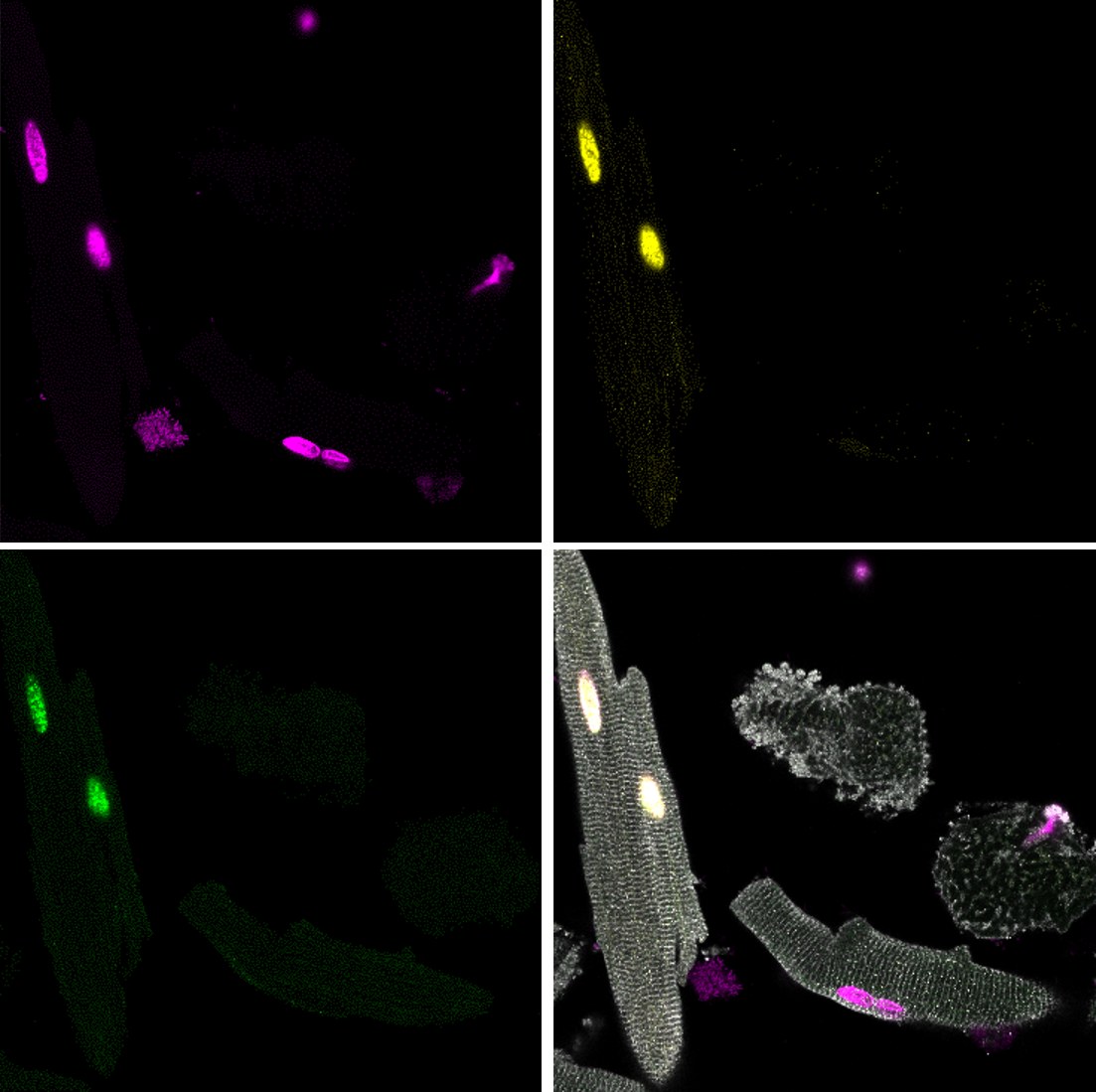
🧩 **What happens inside the cells.** When contraction was inhibited, the sarcomeres fell apart. These are the highly ordered units that make muscle cells shorten. The cells entered the cell cycle and showed markedly more division. When contraction was restored, the sarcomeres reassembled and the cells left the cell cycle again.
⚡ **Metabolism as a switch.** Further analyses showed, according to CNIC, that cells without contraction shifted toward glycolysis, a way of producing energy typical of immature and dividing cells, and relied less on the energy-hungry processes that continuous beating needs. This reprogramming appears to create the conditions in which the cells can divide again. Once contraction returned, the mature metabolic profile came back too.
💬 **What the researchers say.** "The heart has evolved to prioritize continuous function over regeneration," Weinberger says. The machinery that keeps us alive, he adds, is the same that prevents the cells from replacing damaged tissue. PhD student Rajiven Srikantharajah stresses that contraction is not simply incompatible with cell division but actively suppresses the regenerative potential. Nancy Shehata of the University Medical Center Hamburg-Eppendorf, a visiting scientist at CNIC, names the goal: if the cells' capacity to divide could be unlocked temporarily without compromising heart function, the heart's own regenerative potential might one day be stimulated.
🇩🇪 **German partners.** Alessandra Moretti of the German Centre for Cardiovascular Research (DZHK) in Munich says her team showed that the principle also holds in native adult human heart tissue, not only in model systems. Thomas Eschenhagen of the University Medical Center Hamburg-Eppendorf says the braking effect of contraction had long been assumed; now it is proven, independently by other groups as well. Shehata is first author; the paper is titled "Contraction governs cardiomyocyte cell cycle activity".
💶 **Funding.** Funders include the DZHK, the European Research Council through the Advanced Grants IndivuHeart and EPICURE, the EU's Horizon 2020 programme, the German Research Foundation, Spain's science ministry, the "la Caixa" Foundation, the German Heart Foundation and the German Cardiac Society.
⚠️ **Limits.** Whether a human heart could be put into a dividing state on purpose and safely is an open question: a heart cannot simply stop beating. The authors therefore speak of a new biological principle and possible targets, not of a treatment, and say the road to a therapy for patients after a heart attack is still long.