🦠 When oxygen runs short, colonies of the gonorrhoea bacterium turn themselves inside out
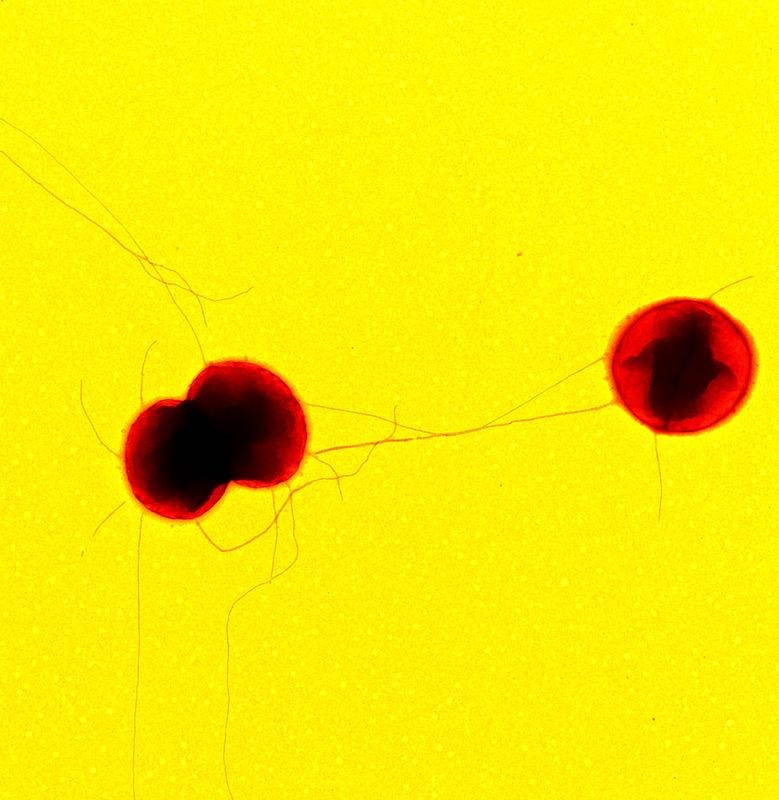
In brief
- 🔬 Colonies of Neisseria gonorrhoeae, the bacterium behind gonorrhoea, turn inside out when oxygen runs out at their centre.
- 🧲 The cause: bacteria inside make fewer sticky filaments (pili) and hold together more weakly, so the core flows outwards.
- 💊 The finding from Cologne and Dortmund, published in Nature Physics, matters for research into bacterial antibiotic tolerance.
🦠 Bacteria protect themselves against antibiotics and the immune system by forming colonies. A team led by biophysicist Berenike Maier at the [University of Cologne](https://www.uni-koeln.de) has now watched such colonies of the gonorrhoea pathogen Neisseria gonorrhoeae turn themselves completely inside out. The study appeared in the journal Nature Physics; TU Dortmund, Wenzhou Business College in China and Universidade NOVA de Lisboa in Portugal also took part. 🔬 The mechanism: the bacteria use up the oxygen at the colony's centre as they respire. In response, they produce fewer type 4 pili there, molecular filaments with which they hold on to one another. Cohesion inside then becomes weaker than at the edge. A physical model shows that this arrangement turns unstable: the weakly bound cells flow in a directed stream to the oxygen-rich surface, and the colony everts. This matters for medicine because bacteria in the oxygen-poor interior of a colony are, in a sense, asleep and thereby protected against many antibiotics. The experiments were done in the lab; the team next wants to test in infection models whether the same happens in the body.
⏱️ How the eversion unfolds. The preprint of the study, posted on bioRxiv in January, describes the experiments in more detail. The researchers grew colonies in a flow chamber under the microscope with a constant supply of nutrients. For the first hours, the colonies grew as spheres, and dead cells and free DNA collected at the centre. After about five hours, at an average radius of around 23 micrometres, the picture changed: a stream of cells shot like a jet from the centre to the edge and broke through the surface. Some of the cells then spread around the former core, others detached. The process took several hours, and the larger a colony was, the more likely it was to evert.
🧲 Why adhesion decides. Pili are not just threads but molecular motors: they extend, stick to neighbouring cells and retract again, so the cells constantly pull on each other. According to a hypothesis from embryonic development, cells with different strengths of attraction sort themselves, with the weaker ones ending up outside. That is what happens here to the whole colony once cells in the oxygen-starved core adhere less than the well-supplied shell. In the model, the arrangement becomes unstable when this strongly cohesive shell gets thinner than a critical value, similar to a capillary instability in liquids. How likely eversion is depends strongly on the force of the pili. Measuring these attractive forces inside living colonies was a particularly challenging experiment, says lead author Stephan Wimmi.
🌱 What the bacteria gain. The stream clears dead cells from the core, and living cells that detach found new colonies, so the bacteria spread faster. Maier describes the trade-off: at the centre, bacteria slow growth and metabolism and are thereby protected against many antibiotics, but they get fewer nutrients and less oxygen. How a bacterial community solves this balance between protection and growth is a key question of her research. Benedikt Sabass of TU Dortmund calls it fascinating that the unexpected phenomenon can be explained by a simple physical theory.
🏥 The link to disease. Gonorrhoea is one of the most common sexually transmitted diseases worldwide. The researchers consider it plausible that the pathogen goes through periods of oxygen deprivation during its infection cycle. So far, however, eversion has only been shown in the lab chamber; whether it occurs in tissue and what it means for treatment is open.
Sources
- Differential active adhesion and a capillary instability drive global eversion and dissemination of bacterial colonies (preprint) (bioRxiv)
- Bacterial colonies turn themselves inside out when oxygen is scarce (Phys.org)
- Bacterial colonies turn themselves inside out when oxygen is scarce (University of Cologne via idw)