🌊 El Niño floods in Ecuador: death toll rises to 34, about 47,000 people left homeless
In brief
- 🌧️ Heavy rains that Ecuador links to El Niño have killed 34 people since late August, the national risk management agency SNGR said on Friday.
- 🏠 About 47,000 people have lost their homes or had to leave them, some 31,000 homes are damaged and 23 people were injured.
- 🌊 32 rivers have burst their banks and 17 more are rising; Esmeraldas, Guayas, Los Ríos and El Oro on the coast are hit hardest.
- 📅 Nine days ago the agency still counted 16 dead.
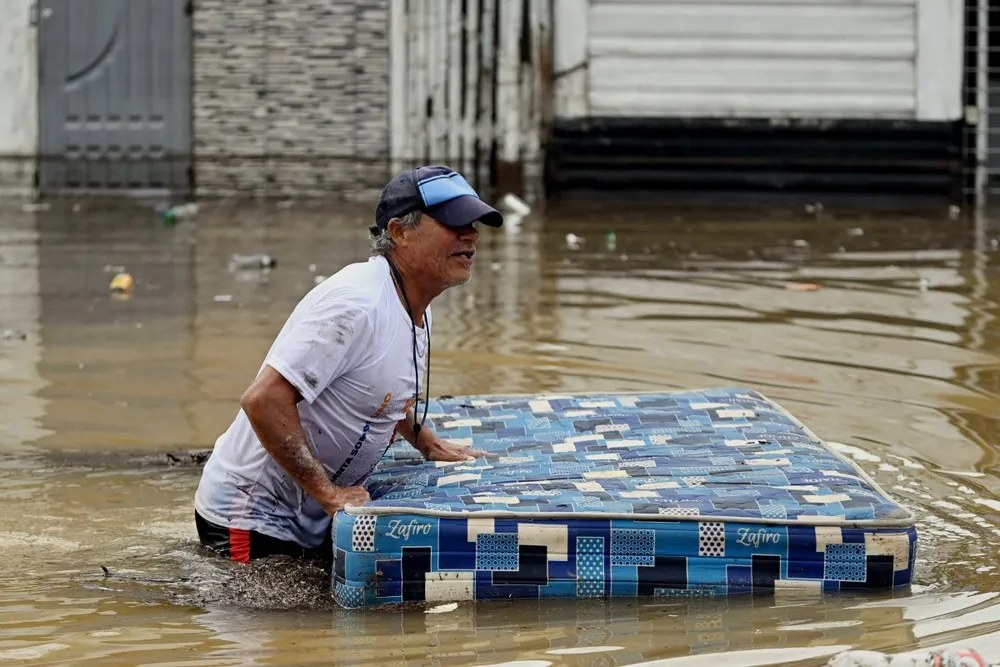
🌧️ The rains that have battered Ecuador for weeks, and that the government attributes to the El Niño climate pattern, have now killed 34 people, according to the national risk management agency SNGR (Secretaría Nacional de Gestión de Riesgos). The agency gave the figure on Friday, the news agency AFP reports. The count runs from 29 August, when Ecuador declared a nationwide emergency because of El Niño. 🏠 About 47,000 people have lost their homes or had to leave them, 23 people have been injured and some 31,000 homes are damaged. The SNGR counts 32 rivers that have overflowed and is watching 17 more whose levels are rising. Most of the flooding is on the coast; the provinces of Esmeraldas, Guayas, Los Ríos and El Oro are the worst affected. 🚒 In the port city of Manta, in Manabí province, residents waded through chest-deep water on Friday, floated on mattresses and waited for firefighters who moved through the streets in canoes. The death toll has roughly doubled in nine days.
📈 **How fast the toll has grown.** The SNGR report as of 11 am on 18 November still listed 16 dead, six injured and 36,729 people left homeless, plus 56,224 people affected in other ways. At that point the agency had counted 1,650 damaging events across all 24 of the country's provinces; almost 60 per cent were floods and just over 16 per cent landslides. 25,654 homes were recorded as damaged and 96 as destroyed, 30 bridges as damaged and two as destroyed. The dead listed then included a father and his son who fell into a drainage ditch during a storm in Guayaquil on 13 November and were swept away; they were found only four days later, the Ecuadorian newspaper Extra reported. Since that report the death toll has more than doubled and the number of people left homeless has risen by about 10,000.
🏘️ **Living in the mud.** In Manta, AFP spoke to Fernanda Navarrete, 41. The Manta river, which shares the city's name, has been pushing water and mud into the house she shares with her sister and her sister's children since Tuesday night. On Wednesday she spent more than twelve hours in waist-deep water; on Thursday the water receded and left mud and rubbish behind, and on Friday morning it stood knee-high in the house again. She has lost beds, mattresses, clothes and household appliances, and the sewers have burst as well. She said she had not seen flooding of this size for a long time.
💧 **Worries about health and supplies.** Tap water comes out murky, food is running short and illnesses are appearing, Navarrete said. Her nephews had a fever for three days and still have to help shovel out the mud that remains every time the water drops.
🌉 **Bridge collapse, roads closed.** In Los Ríos province, where according to the newspaper El Comercio 16 of the 32 river overflows were recorded, a bridge over the Cristal river collapsed in Montalvo canton on Friday. The emergency service ECU 911 reported no injuries. Police and the transit commission CTE diverted traffic; several roads around Babahoyo, Montalvo and Vinces are closed because of flooding, erosion and damage, the Brazilian newspaper O Globo reports.
📜 **The comparison with 1997-98.** The strongest El Niño event in Ecuador since 1950 was that of 1997 to 1998. According to official figures it killed almost 300 people and left about 20,000 homeless. The current season is far below that in deaths but has already left more than twice as many people homeless. How the situation develops depends on whether the 17 rivers the SNGR is watching also overflow.
📰 The figures come from the SNGR as relayed by AFP; we could not access the agency's latest situation report itself. Older reports in Ecuadorian media give partly different numbers because they define people made homeless and people otherwise affected differently.