🔭 Welopōʻai: triple-star system 28 light-years away should not exist
In brief
- 🔭 A Université de Montréal team found two white dwarfs and a red dwarf just 28 light-years away.
- ⭐ A white dwarf and the red dwarf orbit closely, the second white dwarf circles the pair; nothing comparable is known within 100 light-years.
- ❓ The red dwarf survived its partner's giant phase: "This system should not exist".
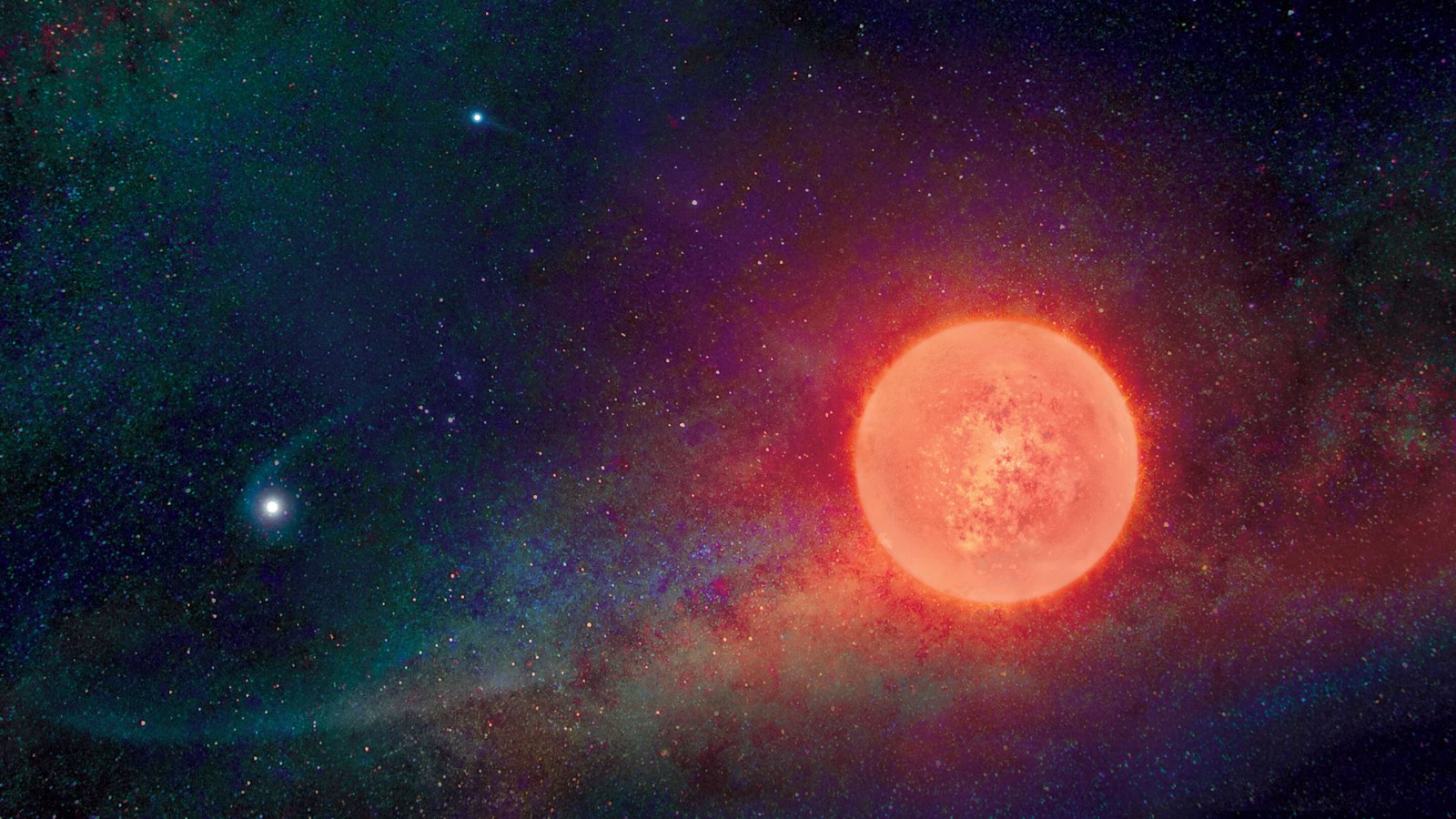
🔭 Astronomers led by the Trottier Institute for Research on Exoplanets (IREx) at Université de Montréal have found a triple system just 28 light-years away and named it Welopōʻai. It consists of two white dwarfs, the burnt-out remnants of sunlike stars, and a dim red dwarf. One white dwarf and the red dwarf orbit each other closely, while the second white dwarf circles the pair. The result appeared in Astronomy & Astrophysics. How the red dwarf survived its partner's giant phase is a puzzle; the team has no clean explanation.
**A chance find.** The team was using the SPIRou instrument at the Canada-France-Hawaii Telescope on Maunakea to look for planets around the red dwarf. Such planets show up as tiny wobbles in a star's velocity. Here the variations reached nearly 16 kilometres per second, more than 1,000 times what was expected. After several years of follow-up the team established that the unseen companion has more than half the Sun's mass and is extremely faint. Co-author Charles-Antoine Parent says that left only the remnant of a dead star; a white dwarf was the most likely explanation, a neutron star or black hole could not be ruled out.
**Direct detection.** The ʻAlopeke instrument on the Gemini North telescope, also on Maunakea, delivered high-resolution images showing the faint companion as a white dwarf. A second, much more distant white dwarf was already known to belong to the system. The newly confirmed white dwarf's mass is measured to better than one percent, which is rare and a valuable test of models of stellar evolution and of the physics of extremely dense matter.
**The puzzle.** Before its end the companion was a star about 40 percent more massive than the Sun. As a red giant it swelled to several hundred times its size, and the red dwarf must have been close enough that a dramatic interaction was almost inevitable. Usually the swollen star engulfs its companion or the two merge. Here the red dwarf survived and sits in a surprisingly wide, stable orbit. Co-author Patrick Dufour says: "This system should not exist." Next the team wants to study the gravitational interactions among the three stars to see whether they explain the history.
**The name.** Welopōʻai was chosen through A Hua He Inoa, a programme of the ʻImiloa Astronomy Center of Hawaiʻi; it combines "welo" (an inherited trait) and "pōʻai" (an orbit), roughly a "path of family traits".