🔭 Euclid releases observations of more than 900 million galaxies
In brief
- 🛰️ The European Space Agency has released the first major dataset from its Euclid space telescope.
- 🗺️ Around 13 months of observations lay the groundwork for a three-dimensional map of the cosmos.
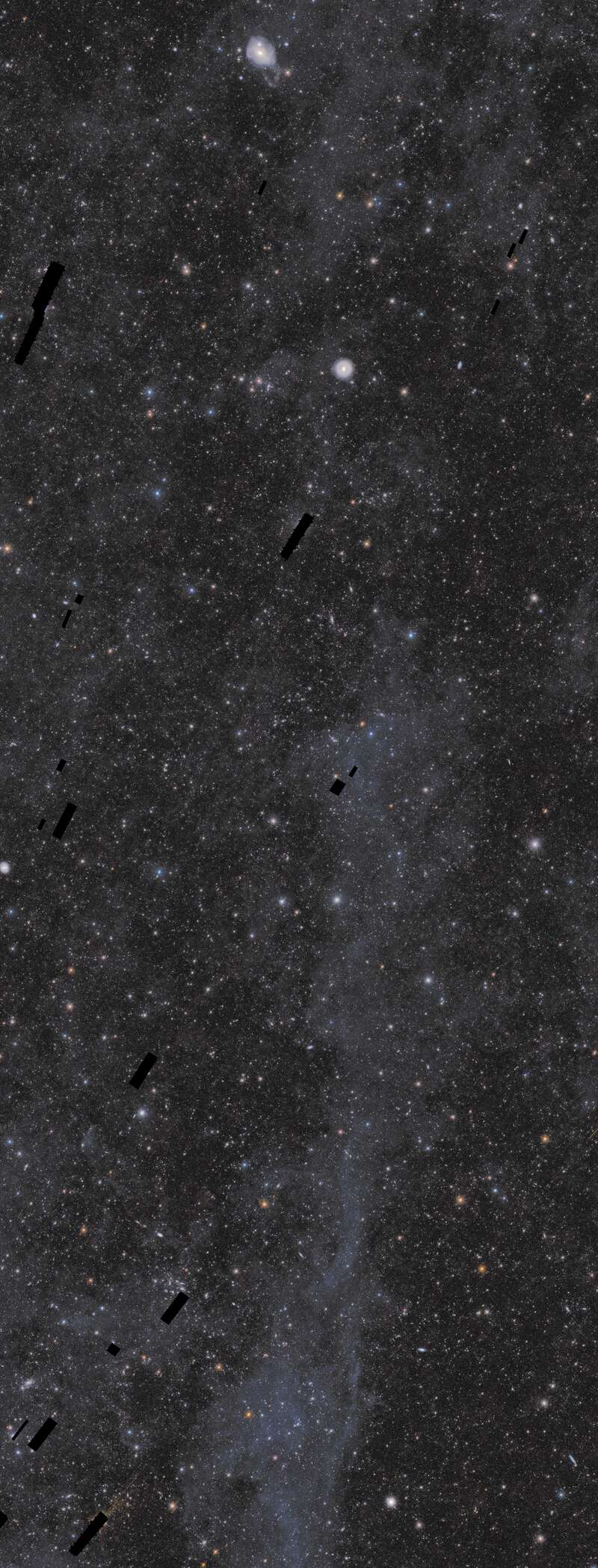
🌌 The Euclid space telescope recorded more than 900 million galaxies in around 13 months. The European Space Agency released the images and measurements on November 12. Researchers can use them to study how galaxies are distributed in space and how dark matter and dark energy shape that distribution.
📊 The dataset, called DR1-Foundation, covers 1,900 square degrees, about the area of 9,500 full moons. It includes images and spectra for more than 160 million sources. A spectrum measures how much light arrives at different wavelengths. Distinctive lines in that light can help estimate an object’s distance. Combining distance with position on the sky allows scientists to build a three-dimensional map.
🔬 The dataset also contains about 15,000 candidates for strong gravitational lenses. In those systems, the mass of a foreground galaxy bends light from a more distant galaxy enough to create arcs or multiple images. Scientists can use the distortions to estimate the foreground mass, including matter that emits no light. ESA expects the full first data release in mid-2027, with more measurements of galaxy distribution and weaker lensing effects.
