🔭 Future LISA mission could find planets through their effect on gravitational waves
In brief
- 🌌 Two studies explore a search method around pairs of white dwarfs.
- 📡 A planet could produce measurable changes in their gravitational-wave signal.
- ℹ️ This is a proposal for the planned LISA mission, not a planet discovery.
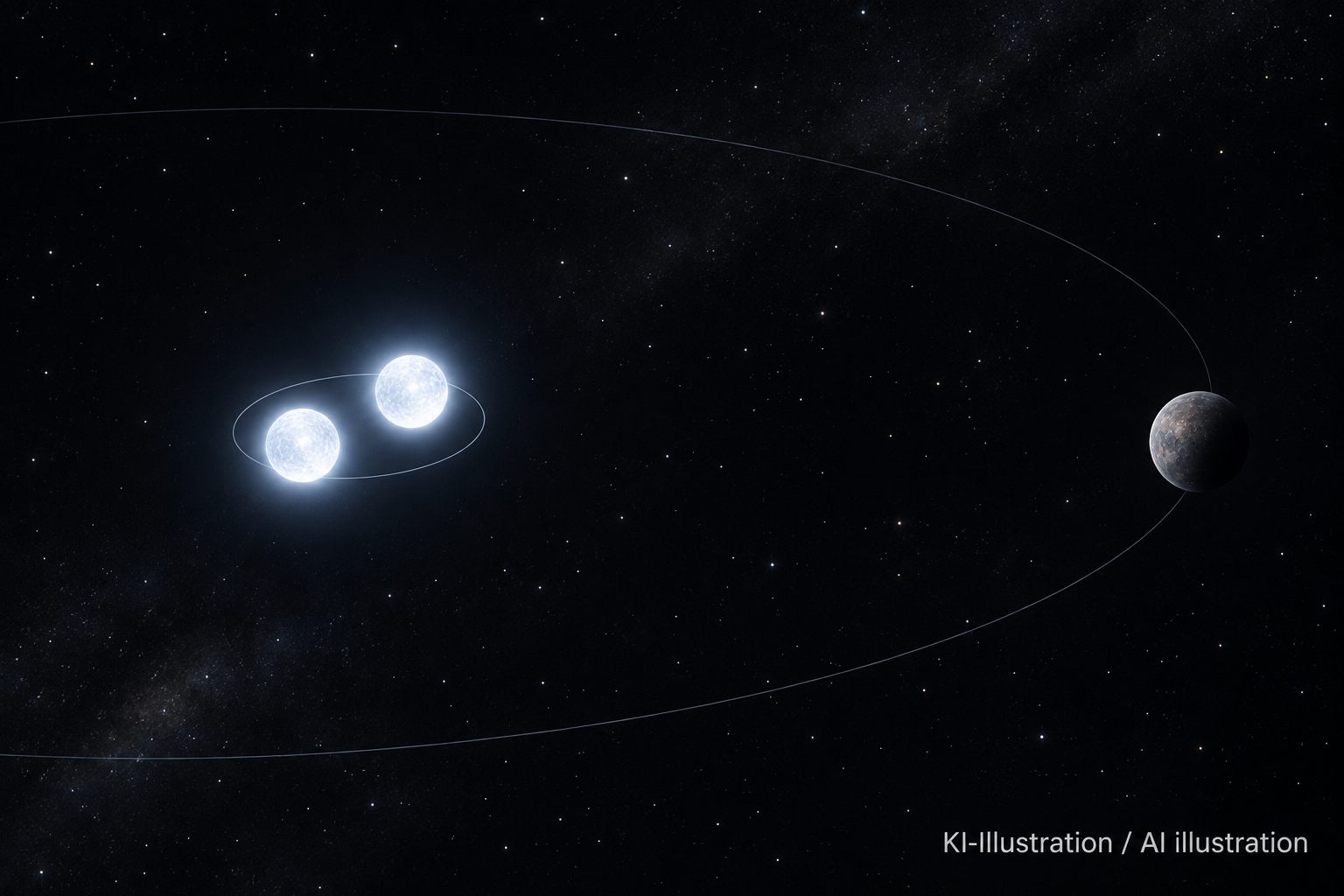
🪐 Planets orbiting pairs of white dwarfs might reveal themselves through small changes in gravitational waves. Two studies presented on November 10 examine this approach, NASA reports. The planned ESA-led LISA mission, with NASA participation, is intended to measure such signals in space. No planet has been detected using LISA.
⭐ White dwarfs are dense remnants of former stars. A close pair generates a continuing gravitational-wave signal. The gravitational pull of an additional planet would move the pair slightly, potentially producing a repeating shift in the measured signal.
🔬 The researchers also examine how infrared observations with the James Webb Space Telescope could help check a possible candidate. The methods would probe different properties.
📅 LISA is planned for the mid-2030s. Three spacecraft are intended to form a laser-linked triangle with sides about 2.5 million kilometres long. The studies describe the potential of future measurements; they do not demonstrate an operational LISA detector or the discovery of a new planetary population.