🛰️ BepiColombo enters Mercury orbit after an eight-year journey
In brief
- 🪐 BepiColombo is orbiting Mercury with its European and Japanese spacecraft still attached.
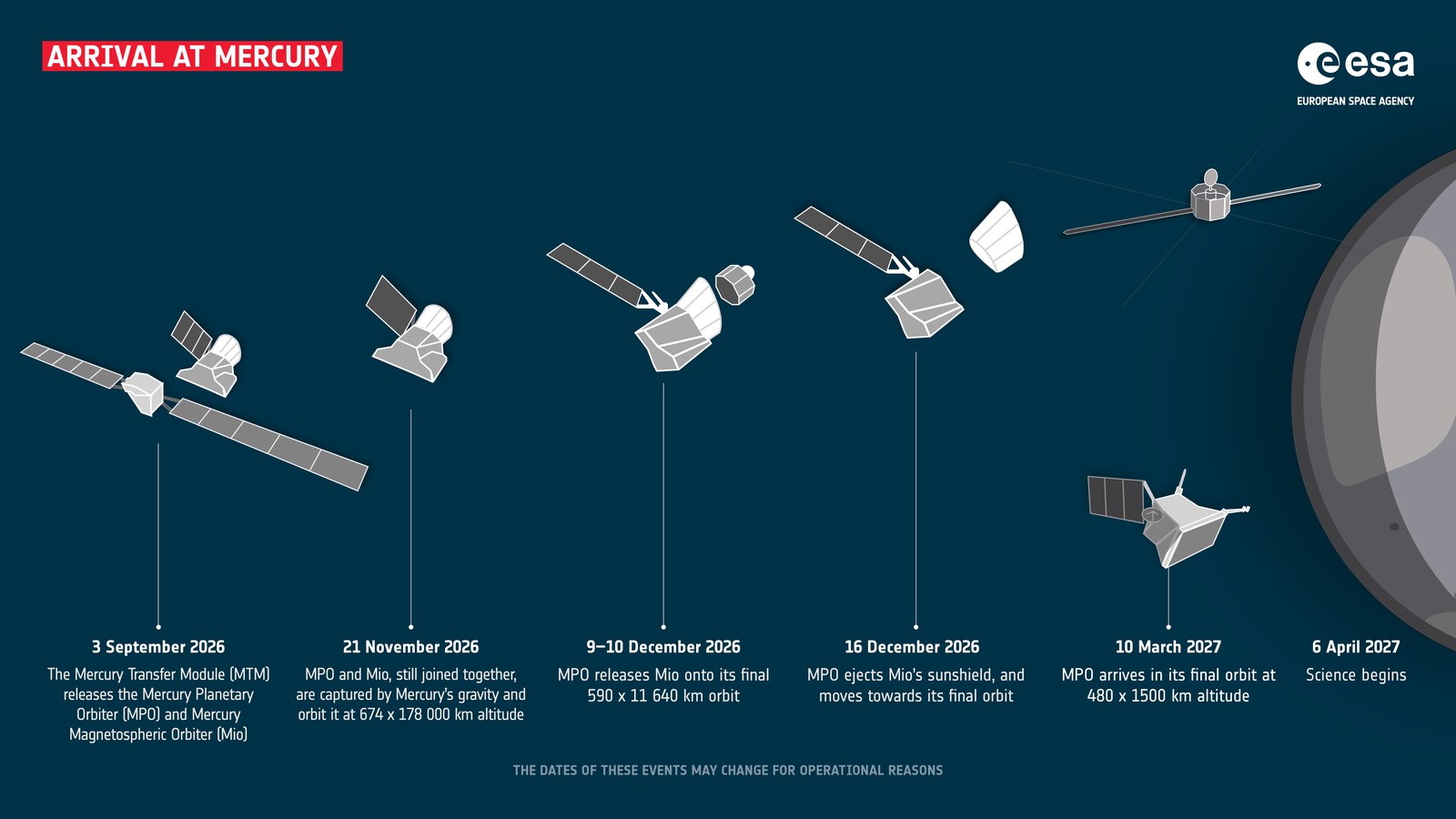
- 📅 Separation is scheduled for December 9–10. Routine science operations are planned for April 2027.
🔭 BepiColombo has reached the planet closest to the Sun after eight years in flight. Mission controllers confirmed that the joined spacecraft entered Mercury orbit. The pair are due to separate in December. Europe’s Mercury Planetary Orbiter will focus on the planet itself. Japan’s Mio will study its magnetic field and surrounding environment. The joint science campaign is scheduled to begin in April 2027.
🧭 The route took BepiColombo past Earth once, Venus twice and Mercury six times. Each flyby helped reshape the spacecraft’s path around the Sun and adjust its speed. A spacecraft gains speed as it falls toward the Sun, so the approach has to shed enough velocity for Mercury’s much weaker gravity to capture it.
📡 The pair shed their transfer module in September. The European orbiter took charge of steering for the last part of the approach. After separation in December, Mio will remain in an elongated orbit. The European probe is scheduled to release Mio’s sunshield and keep lowering its own orbit until March. The agency says operational needs could alter the timetable.
🔬 NASA’s Messenger was the last long-term visitor and worked in Mercury orbit from 2011 to 2015. Having two active spacecraft at once lets scientists compare simultaneous measurements from different places. That can help establish whether the planet’s environment is changing over time or whether two instruments are simply sampling regions that have different magnetic field strengths.