🔭 Astronomers find the oldest known quasar: a black hole 630 million years after the Big Bang
In brief
- 🔭 The quasar “Dún Aonghasa” dates to 630 million years after the Big Bang, about 40 million years earlier than the previous record from July.
- Its black hole has roughly 360 million solar masses, about 90 times that of the Milky Way's.
- ESA's Euclid space telescope found it; ground- and space-based telescopes followed up.
- How such a large black hole formed so early is still open.
Astronomers have identified the oldest known quasar. It dates to more than 13.1 billion years ago, when the universe was only about 630 million years old, less than 5% of its current age, and about 40 million years earlier than the previous record holder, disclosed in July. According to lead author Julien Wolf of the European Southern Observatory, its central black hole had already grown to about 360 million times the mass of the sun. The result was published in the journal Astronomy & Astrophysics.
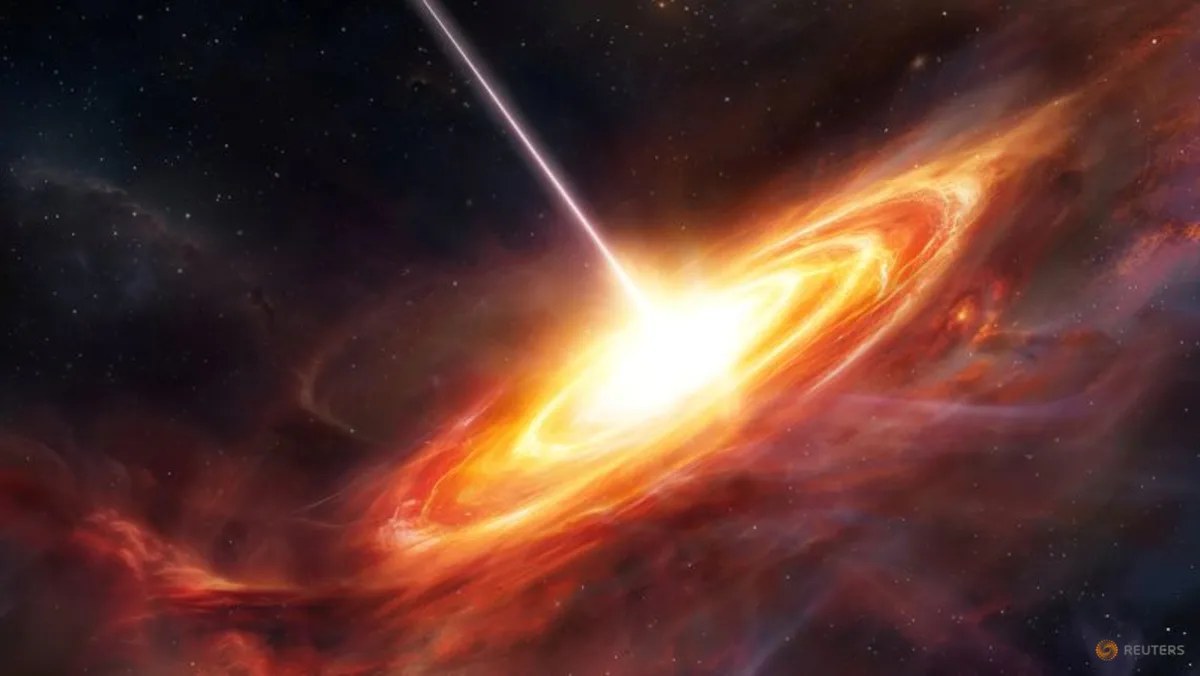
**What a quasar is.** A quasar is the enormously bright core of a galaxy, powered by a supermassive black hole. Gas, dust and matter fall toward it, form a swirling accretion disk and heat up so much that it can outshine the rest of the galaxy by factors of hundreds or thousands. That is why quasars can be seen across billions of light-years and help astronomers study the early universe, says co-author Silvia Belladitta of the Max Planck Institute for Astronomy.
**The discovery.** The quasar was first detected by the European Space Agency's Euclid space telescope and then characterised with a combination of ground- and space-based telescopes. The team nicknamed it Dún Aonghasa, after an ancient stone fort on a cliff above the Atlantic in Ireland.
**Why it is puzzling.** The black hole is about 90 times more massive than the one at the centre of the Milky Way. It grew in a short time, which "challenges our understanding of how black holes can grow so large so quickly in the early universe," Belladitta said. Two explanations are offered: it may have started small as the remnant of a first-generation star, but the observed rate of feeding was too slow to build the mass so fast; or it may have been born big through direct collapse, in which a gas cloud stays warm enough not to break into many stars and flows toward the centre, where a single enormous star quickly collapses into a black hole.
**The epoch.** After the Big Bang the cosmos cooled into a dark fog of neutral hydrogen. The first stars and galaxies burned through it with their radiation, making the universe transparent for the first time. That process was still under way when this quasar formed.
**Outlook.** Euclid may still find older quasars; theoretical models suggest the first quasars could date to 270 to 470 million years after the Big Bang. "This is the furthest quasar we have ever seen, but maybe not the furthest there is to find," Belladitta said.