Bangladesh police tear-gas garment workers a day after the wage rise 🧵
In brief
- 🚨 Police in Gazipur fired tear gas and sound grenades at workers who tried to block a major highway.
- 💶 The trigger: a minimum wage rise of just 36% to 17,000 taka.
- 🏭 A local report counted at least 25 injured in Savar on Wednesday.
- 👮 Police say calm has returned but remain on alert.
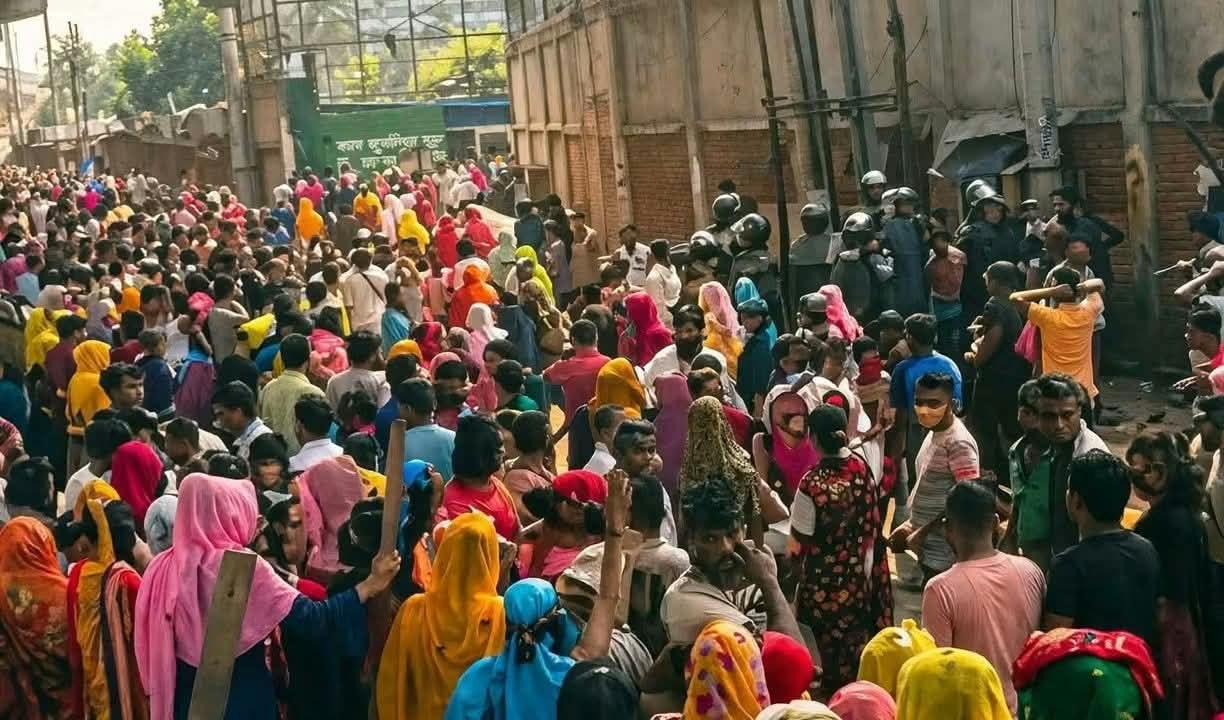
🚨 Police in Bangladesh fired tear gas and used sound grenades on Thursday against garment workers who tried to block a major highway in Gazipur, a clothing-industry hub near Dhaka. Police said protesters set fire to a police motorcycle and that calm was later restored. 💶 The unrest came a day after a wage board raised the sector's monthly minimum wage by 36% to 17,000 taka. Reuters-based reports call it the smallest percentage increase since the first sector minimum in 1986, far short of what workers had demanded. The industry employs more than four million people.
👮 **On the ground.** Mohammad Amjad Hossain, superintendent of Gazipur Industrial Police, said the situation was now calm but that officers remained on alert. Gazipur has been at the centre of the workers' agitation.
🏭 **Wednesday in Savar and Ashulia.** The unrest did not start on Thursday. According to the Bangladeshi news site [The Times of Bangladesh](https://tob.news/at-least-60-factories-shut-25-injured-as-worker-unrest-escalates/), at least 25 people, police officers among them, were injured in Savar on Wednesday. Workers of the Standard Group and the Babylon Group gathered at an intersection after rejecting the new wage structure. When they tried to push past a police blockade towards the Dhaka–Aricha highway, police fired sound grenades and tear gas, the report says, and workers threw pieces of brick. Eleven factories were closed under the labour law and 60 more declared a holiday. A closure on that legal basis means no work, no pay. Border Guard units were deployed alongside police.
⚖️ **How the decision was reached.** The six-member board voted four to two in the early hours of Wednesday after nearly 12 hours of talks. The two dissenters backed 18,000 taka, [The Independent](https://www.independent.co.uk/asia/south-asia/bangladesh-garment-worker-protest-wage-b3092063.html) reports, citing workers' representative Babul Akhter. Workers had first asked for 32,000 taka, while factory owners opened at 15,000. The new grades run from 17,000 to 21,500 taka, taking effect on 1 December, with the revised pay expected from January. Earlier rises were 77% in 2013, 51% in 2018 and 56% in 2023.
📉 **Cost to industry.** The manufacturers' association BGMEA said 397 factories could not operate on Tuesday and 84 more stayed shut. Its survey put lost production at 317 factories at about $428 million over 18 days of disruption, with orders worth about $254 million moved to other countries.
🌍 **Brands and critics.** The sector supplies H&M, Zara, Next, Walmart, Target and Gap, among others. Anne Bienias of the Clean Clothes Campaign called the outcome poverty wages and criticised brands for neither openly backing a higher rate nor committing to absorb the extra labour cost. ACT, a group of brands and unions, said before the decision that its brand members, including Inditex, H&M and Primark, had pledged to reflect wage increases in their purchasing prices. Mohiuddin Rubel of manufacturer Denim Expert warned instead that the country's cost advantage was gone and said buyers must share the burden.
🔎 The protests coincide with political tensions over former Prime Minister Sheikh Hasina's plan to return to Dhaka from exile in India. Together they have fuelled fears of renewed instability.