🛰️ Voyager 1 is expected to reach one light-day from Earth on November 18
In brief
- 📅 NASA expects the symbolic distance milestone on November 18.
- ⏱️ Light and radio signals will then take about 24 hours to travel one way.
- 🔭 Launched in 1977, the probe continues measuring the environment beyond the solar-wind bubble.
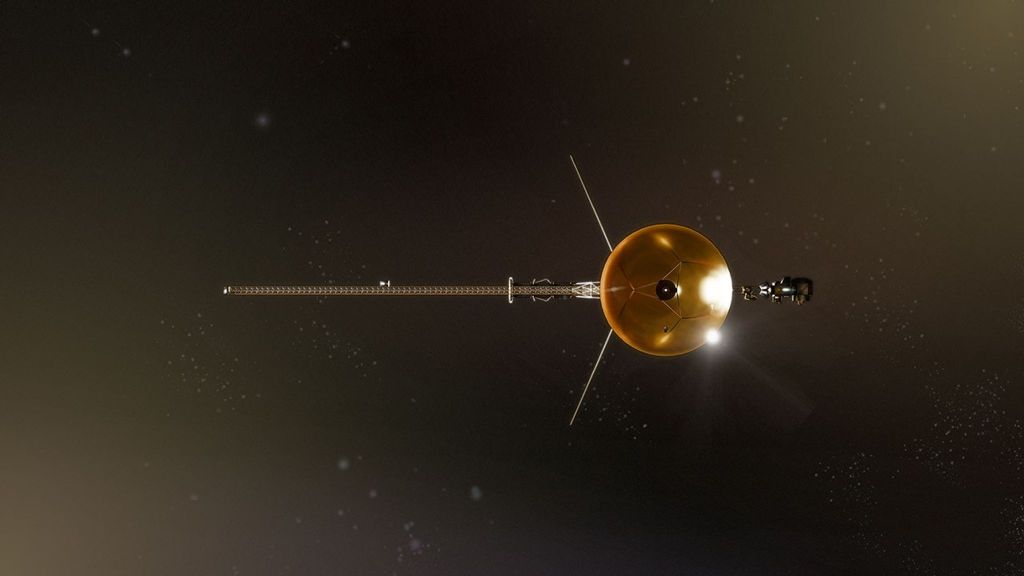
🌌 Voyager 1 is expected to reach a distance of one light-day from Earth on November 18. NASA puts that at more than 25.9 billion kilometres. A radio signal takes roughly 24 hours to cover the distance in one direction. The agency announced the approaching milestone on November 10. Launched in 1977, the spacecraft continues sending measurements from interstellar space.
A light-day is a measure of distance: how far light travels in 24 hours. For Voyager operations, that means long waits. Even an immediate response to a command sent from Earth could return only about two days after transmission, combining the outward and return journeys.
Voyager 1 crossed beyond the heliosphere, the region shaped by the solar wind, in 2012. Voyager 2 followed in 2018. They provide measurements of an environment that no other active spacecraft currently studies in person.
NASA also plans a “Shine Bright” public activity on November 17 after local sunset. A Jet Propulsion Laboratory discussion and question session follows on November 19 at noon US Eastern time, or 6pm in Vienna. These are announced events: the one-light-day milestone has not yet been reached at the time of this report.