🧮 Riemann hypothesis: independent checkers accept the proof developed with Claude
In brief
- 🧠 The Lean and Mathlib teams endorse the proof Levent Alpöge developed with Claude.
- 🔢 It locates the zeros of a function connected to the distribution of prime numbers.
- 🧪 Independent technical checks have passed. The Clay Institute still lists its prize problem as unsolved.
📐 One of the most famous open questions in mathematics now has an independently checked proof. The Lean and Mathlib teams say the argument Levent Alpöge developed with Claude shows that all nontrivial zeros of the Riemann zeta function lie on a particular vertical line. That claim from 1859 helps describe the distribution of prime numbers much more precisely. The teams compared the theorem with the established statement and used several programs to check the reasoning. An MIT verification log reports successful checks for related Dirichlet L-functions as well. The Clay Mathematics Institute still lists its Millennium Prize Problem as unsolved.
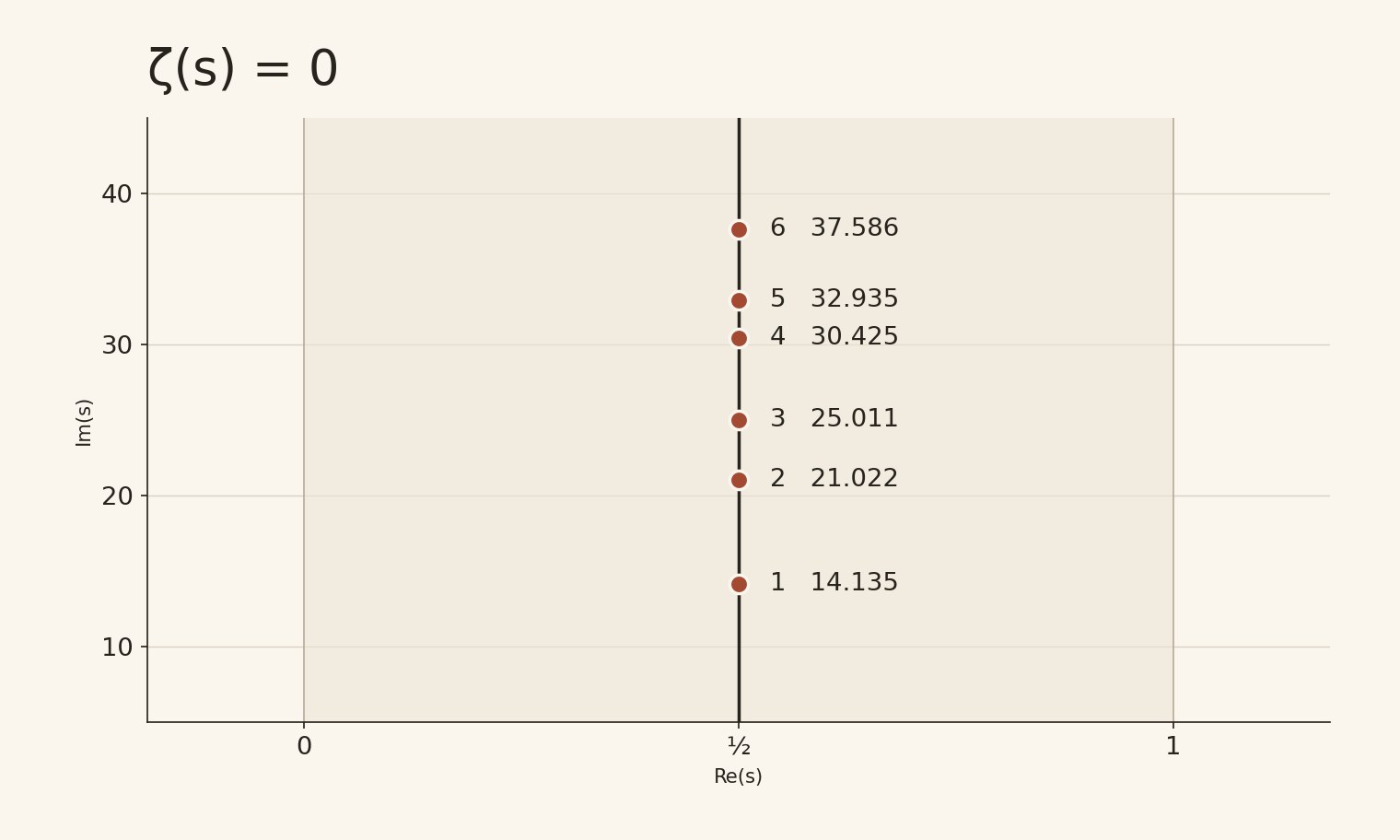
**From prime numbers to a line.** Count the primes up to 100 and you get 25. Count up to a million and you get 78,498. Approximations describe how that count grows. A deeper question is how far the actual count can stray from the approximation as the upper limit gets very large. The Riemann zeta function connects that question to the points at which a function of complex numbers is zero. A complex number has two coordinates. In the graphic, all six selected points have a horizontal coordinate of one half. The figure illustrates the critical line and shows a finite slice of a question about infinitely many zeros.
**What it means to check a proof by computer.** A conventional proof offers readers a chain of deductions. Lean requires a description precise enough for a small checking component to follow that chain. Definitions matter. Change a crucial definition and a program can run successfully while answering a different question. The checkers therefore placed the established Mathlib statement in a separate file and compared the two versions with independently developed tools. Other programs then checked the exported proof objects.
The checks dealt with an unusually large submission. Andrew Sutherland at MIT records that all 175,187 modules compiled without errors. A separate, isolated build produced the same roughly 61.6-gigabyte export. The checkers also accepted statements about Dirichlet L-functions. These functions help study primes grouped by the remainder they leave after division by a fixed number. The result for this family has a narrower scope than some broader extensions of the classical conjecture.
**The next step is making the argument readable.** Alpöge describes directing the mathematical investigation and credits Claude with critical ideas along the way. Turning the large formal argument into a readable exposition is a separate task. A working draft on Michael Rubinstein’s University of Waterloo site sketches how parts of the argument can be explained using weighted sums over primes and their powers. The draft identifies which central ingredients it still takes from Lean. Readers can distinguish the claims that have already been checked formally from the incomplete account of how to understand them in conventional mathematical prose.
The Clay Institute offers a million-dollar prize for a solution it recognizes. Its procedure requires, among other things, a qualifying publication, a two-year wait and broad acceptance in the international mathematics community. The Lean and Mathlib checks are independent of that prize process.
Sources
- Visual explanation of the Riemann zeta function (3Blue1Brown)
- Verification files for the Lean proof (Andrew Sutherland, MIT)
- Riemann hypothesis: problem and listed status (Clay Mathematics Institute)
- Rules for the Millennium Prize Problems (Clay Mathematics Institute)
- No known copyright restrictions (Flickr Commons)
- Independent verification of the Riemann hypothesis (Lean and Mathlib communities)
- Portrait of Bernhard Riemann, 1863 (Smithsonian Institution)
- Working exposition of the zeta-function case (University of Waterloo, Michael Rubinstein)