🛡️ Unidentified drone briefly violates Latvian airspace, NATO jets scrambled
In brief
- 🛡️ An unidentified drone briefly entered Latvian airspace near the Russian border early on Friday.
- 🚨 Ludza municipality was under an orange alert from 02:30 to 02:55, followed by a yellow alert for Balvi until about 03:30.
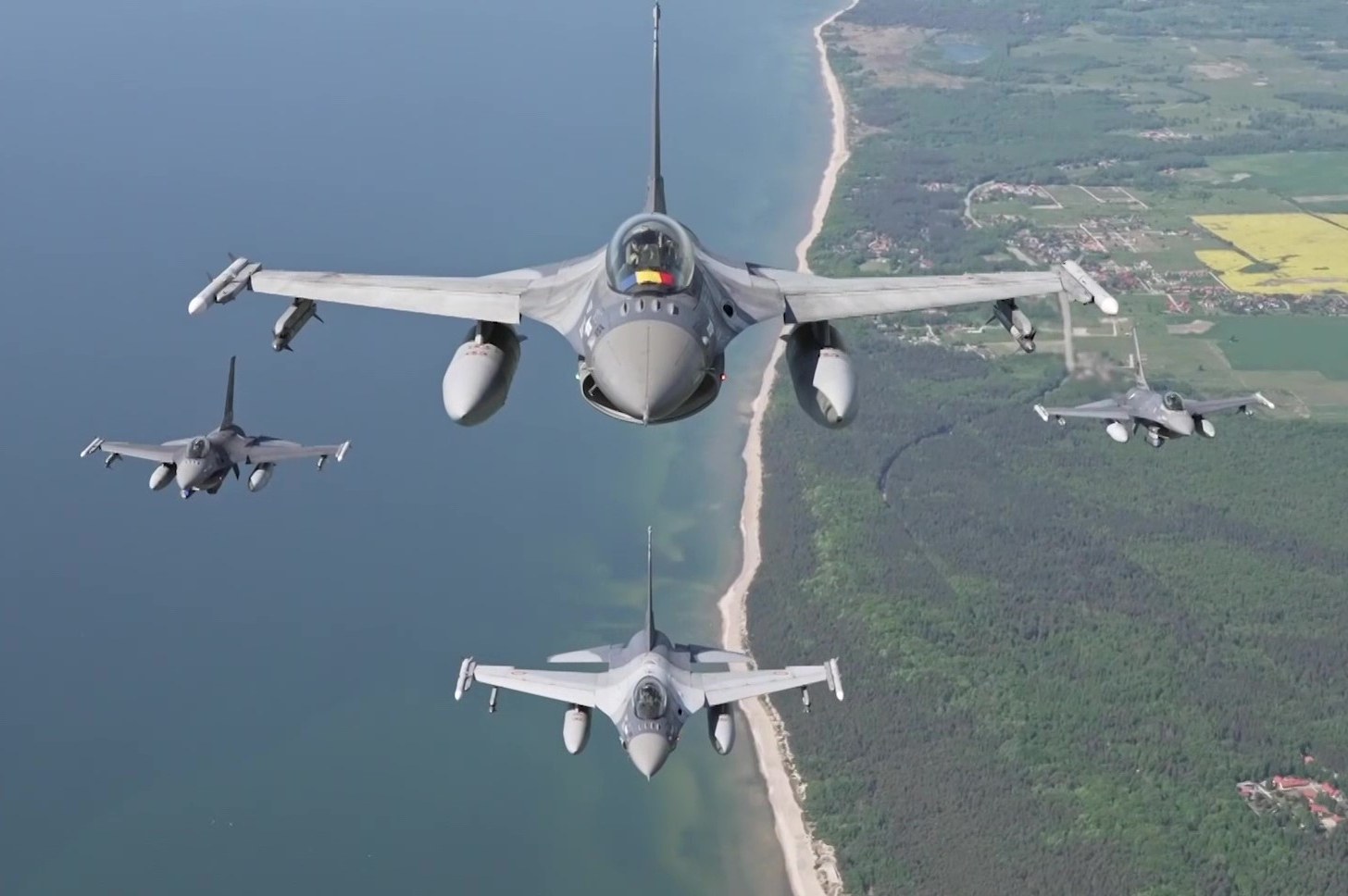
- ✈️ Fighter jets of NATO's Baltic air policing mission were scrambled and Latvia launched an interceptor drone.
- 🌍 At the same time Russia's Leningrad region said it downed more than 40 Ukrainian drones.
🛡️ An unidentified drone briefly entered Latvian airspace in the early hours of Friday, 27 November, Latvia's National Armed Forces (NBS) said. The military detected the unmanned aircraft right at the state border in the east of the country and said it was over Latvian territory only for a short time. 🚨 At 02:30 the armed forces declared an orange alert, which signals an actual airspace threat, for Ludza municipality near the Russian border; residents received the warning on their mobile phones. The threat ended at 02:55. At the same moment a yellow alert for a possible threat was issued for Balvi municipality to the north and lifted at around 03:30. ✈️ In response, fighter jets of NATO's Baltic air policing mission were scrambled and Latvia launched an interceptor drone of its own, which later returned to its launch site. The military did not say whose drone it was. According to Reuters, the alerts came while Russia's Leningrad region was repelling a Ukrainian drone attack, in which Governor Alexander Drozdenko said more than 40 drones were downed. The incident adds to a series of airspace violations on NATO's eastern flank.
📋 **What the military actually said.** The statement of Latvia's armed forces came about an hour after the alerts and is brief. It speaks of the movement of an unmanned aerial vehicle "in the immediate vicinity of the Latvian state border" that was "for a short time" in Latvian territory. It does not give the drone's origin, type or route, nor whether it was armed. Air defence units were ready to respond immediately, it said. No shoot-down is reported; the NATO jets and the interceptor drone apparently had no target left to engage before the threat ended.
🛰️ **The interceptor drone.** Public broadcaster LSM points to one detail: this time Latvia's interceptor drone returned to its launch site. In a similar earlier incident an interceptor was launched but could not find its target over Latvia and was ordered to self-destruct. Alongside fighter jets, Latvia now uses its own, much cheaper interceptor drones against slow intruders.
📱 **How the warning system works.** Latvia warns the public in two levels by cell broadcast, a message to every phone in an area. Yellow means a possible threat: a drone is heading towards a district but is not there yet; people should stay aware but need not act. Orange means a confirmed threat in the airspace. People indoors should then take cover behind at least two walls, drivers should continue to a safe place or get out and seek shelter, and after an explosion people should stay inside for at least ten minutes. The authorities also ask residents not to post photos or videos online, to avoid spreading misinformation and revealing defensive positions.
🗺️ **Why Ludza and Balvi.** Both municipalities lie in Latvia's far east on the border with Russia, not far from the Leningrad and Pskov regions. Ukrainian long-range drones regularly target north-western Russia, and Russian jamming repeatedly pushes drones off course. The same area saw alerts, crashes or NATO shoot-downs in May, June, August and early November 2026; in August, for example, an Italian Eurofighter downed a drone over Balvi.
🌍 **The wider picture.** Reuters describes the incident as another violation of the airspace of a European Union and NATO member. Only on Tuesday Poland accused Moscow of deliberately violating its airspace after a Russian surveillance drone briefly crossed the border. Concern is growing in Europe that the war in Ukraine is spreading beyond its borders. Whether the drone over Latvia was part of the attack on the Leningrad region or a Russian one remains open.