exployt: How one person manages over 100 AI agents at once
In brief
- One person, more than 100 AI agents working in parallel: AI coordinators hand out the work, the human keeps the overview.
- The mission: give individuals the tools that large companies keep for themselves, so AI works for people instead of replacing them.
- Founder Michael M. Schöggl reports up to about 300,000 AI-assisted lines of code a day and roughly 90% lower third-party AI costs, subscriptions included.
- Closed alpha. All figures are the developer's own reports.
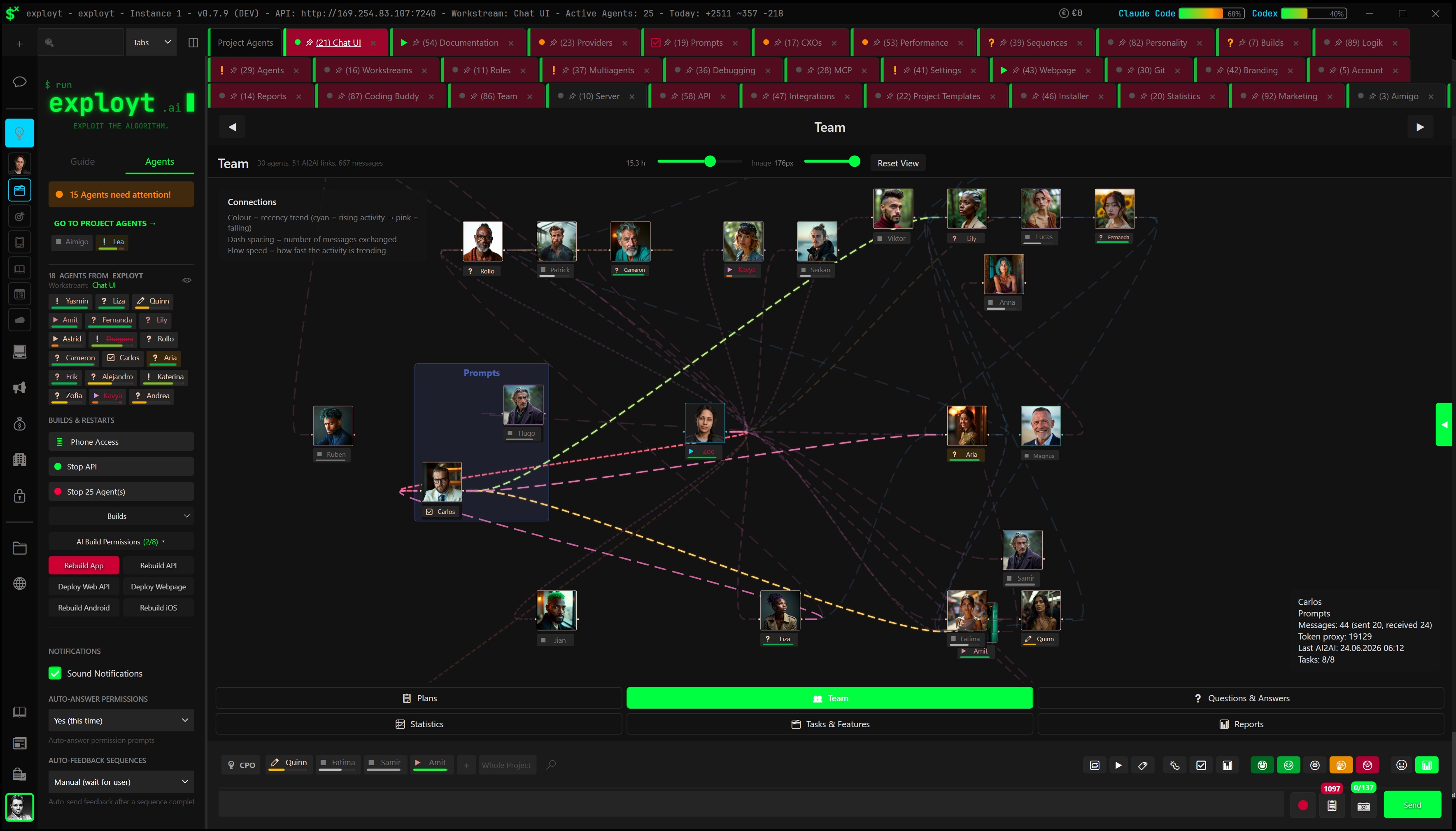
exployt is a desktop platform on which AI coordinators in CTO, CPO, CMO, CFO and COO roles direct more than 100 agents working in parallel, while one person keeps the overview and takes the decisions. Behind it stands a mission: AI could concentrate power in a few large companies, and exployt wants to give individuals the same tools. Founder Michael M. Schöggl reports 100,000 to about 300,000 lines of AI-assisted code per day and roughly 90% lower spending on third-party AI, subscriptions included. The project is in a closed alpha, and the figures are self-reported.
Most people use AI one conversation at a time. exployt starts from a different question: what if one person could run a whole team of AI agents, the way a company runs its departments? Its answer is a desktop platform on which AI coordinators, in the roles of CTO, CPO, CMO, CFO and COO, hand out work to more than 100 agents at once. The person at the top sets permissions, workflows and approval gates, follows the progress and steps in when a decision is needed.
Behind the product stands a mission. The project's manifesto says that the system has exploited ordinary people for a long time, and that the same AI that could replace them can also work for them. The FAQ names the concern plainly: AI could concentrate power in a handful of large companies, which probably build similar tools internally and have little reason to release them. exployt wants to give individuals the same tools. It is aimed mainly at people who have lost a software job to AI or fear they will. The name plays on this: "exploit" as in using the biggest chance in history, and a logo of $ˣ, where x is the number of agents working in parallel and the dollar sign stands for financial freedom and independence.
The project makes three promises. User data stays with the user and is not harvested. The focus stays on individuals rather than large organisations. And prices for individuals are meant to stay affordable in the long term, while business pricing is higher and expected to rise. Code and project data live in a local database on the user's own machine; content leaves it only when the user sends it, for example prompts to the AI provider they have chosen.
Founder Michael M. Schöggl describes himself as a self-taught hobby programmer without a formal degree. He says he built the platform alone in about five months, from around Christmas 2025 to a closed alpha at the end of May 2026, and wrote virtually no code by hand: earlier versions of exployt built the later ones. The codebase grew from about 2 million lines in June 2026 to about 8.5 million by the end of October. He reports more than 100 agents working at the same time and 100,000 to about 300,000 lines of AI-assisted code per day in his own work; the FAQ gives a range of 100,000 to 500,000, depending on workload and setup.
He also reports that his spending on third-party AI, subscriptions included, fell by more than 90%. That comes from more than ten methods. Three are public: "shadow agents", where a cheap model does the reading, research and handover so that the expensive main agent needs only one turn on a fully prepared work order; cheaper or local models for tasks that do not need the strongest one; and persistent memory in the local database, so agents do not have to learn a project again each time. According to Schöggl, these account for about half of the saving, and the rest comes from techniques he keeps confidential. The result depends on workload, models and provider prices.
On the technical side, exployt works with nearly 400 providers and about 2,000 models, including local ones, and with tools such as Claude Code, OpenAI Codex, Cursor and Windsurf. Agents talk to each other directly, workflows are built in a node-based editor, and companion apps for iOS and Android let a user monitor and approve work from a phone. Everything is recorded from the first minute and can be searched and reviewed later.
exployt is in a closed alpha and runs on Windows x64, with macOS on the way. Registering on exployt.ai does not grant access; testers apply in their account. Triumviry and Unicorn Dev already use the technology for client projects and quote about €0.10 to €0.50 per line of code, around a tenth of usual development costs, according to the providers.
A note on the numbers: all figures here come from the developer and the project's own website and have not been checked independently. Disclosure: exployt comes from the same developer as AI Today and All Today, which is why this post is labelled as advertising. Every reader can submit their own projects through "Create post", under the same rules.