🎬 Charlotte Higgins: why cinema in times of war has to take sides
In brief
- 🎬 Guardian chief culture writer Charlotte Higgins calls the old ideal of apolitical cinema obsolete.
- 📽️ Her example is NAZA by Yuval Abraham and Rachel Szor: 24 Israeli soldiers describe how civilian deaths in Gaza are booked as collateral damage.
- ⚖️ Next to it, the Elizabeth Holmes documentary You Can See Everything, with its play on unstable truth, looks irrelevant, she argues.
- 🇺🇦 Her conclusion: documentaries secure the evidence without which there is no justice.
🎬 Charlotte Higgins, the Guardian's chief culture writer, argues in a column of 28 November 2026 that cinema in times of war and catastrophe must take a position, and that this is how it should be. In 2004 the unwritten rule at Cannes was still that politics stayed outside; today, she writes, it would be absurd to separate a film's form from its politics. Her central example is NAZA by the Israeli film-makers Yuval Abraham and Rachel Szor, co-produced by the Guardian. In it, 24 members of the Israeli armed forces describe in flat detail how Palestinian civilians killed with the help of AI count as acceptable collateral damage. The film, Higgins says, shows how responsibility is outsourced to a "system". 📽️ Next to that clarity, the Elizabeth Holmes documentary You Can See Everything, a manipulative film about manipulation, seems irrelevant and decadent to her. Her conclusion: documentaries insist that facts exist, and without documents and testimony there can be no justice. This is her opinion, not a finding of fact.
📜 From taboo to matter of course. Higgins opens with a scene of her own. As a new arts correspondent in 2004 she asked Brad Pitt at the Cannes press conference for Troy whether there were parallels between the Iraq war and the mythical Trojan war. Pitt answered gracefully, but she felt disapproval in the room. That same year Michael Moore's Iraq war polemic Fahrenheit 9/11 won the Palme d'Or, and jury president Quentin Tarantino said the film's politics would not sway the judges: "Politics be damned."
🌍 What has changed since. With identity politics, #MeToo and Black Lives Matter, she writes, it became common knowledge that politics is not only something a film is about but something built into how it is made. At last week's documentary festival in Amsterdam the critic Xan Brooks saw tales of crisis, resistance and human kindness. As a rough barometer Higgins points to the Oscar for best documentary: since Summer of Soul in 2022 only political films have won, among them 20 Days in Mariupol by the Ukrainian director Mstyslav Chernov. Wildlife, sport or even economic exploitation hardly stand a chance now.
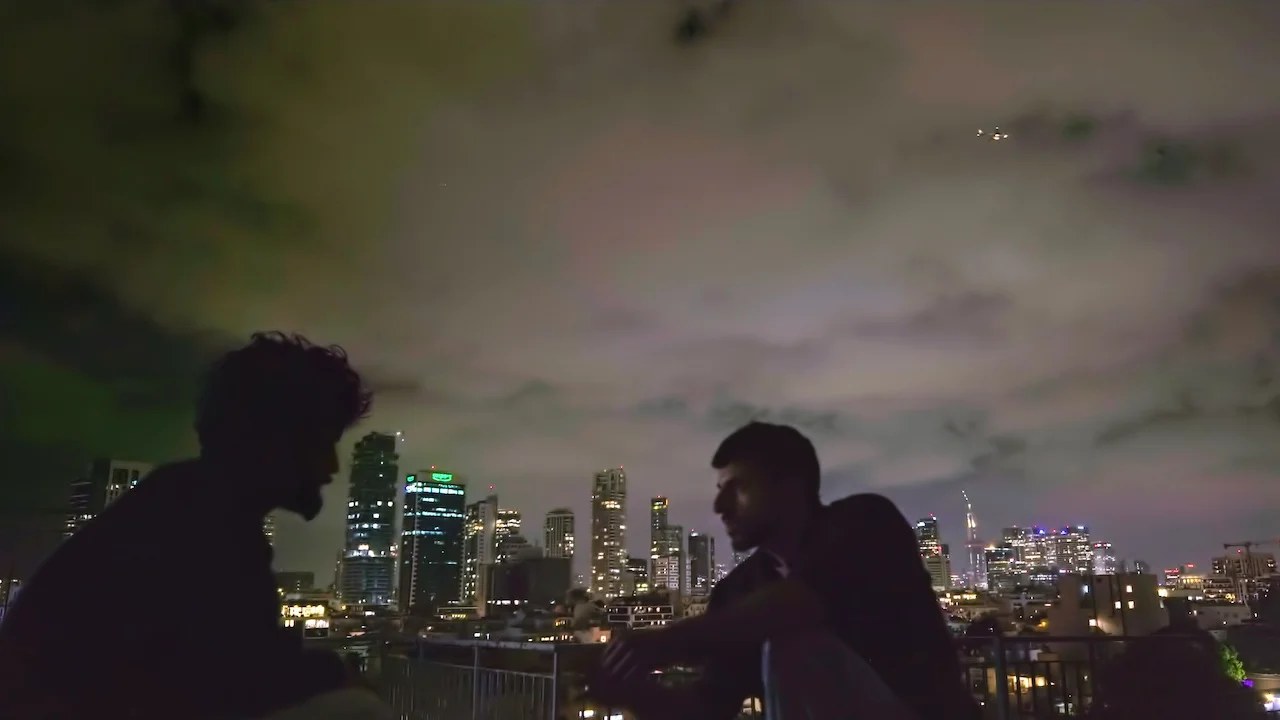
📽️ NAZA in detail. Abraham and Szor were part of the team that won the Oscar for No Other Land with the Palestinian co-directors Basel Adra and Hamdan Ballal. The new film's title, Higgins explains, comes from the Hebrew acronym the Israeli military uses for collateral damage. It was shot at night on Tel Aviv rooftops; glimpses into glassy apartments in the style of Edward Hopper contrast with the ruin of Gaza that the interviewees describe. Higgins calls the tone precise and restrained and says Hannah Arendt should have lived to do justice to the material. Only at the end does the film leave the interviews and show collateral damage as a human reality.
🏆 Background on the film. NAZA premiered in competition at Venice and won the Special Jury Prize there, TheWrap reports. The film-makers say many of its revelations were published soon after 7 October 2023 by the Guardian with +972 Magazine and Local Call; the film lets them show what is not said as well, the silence. Jonathan Glazer is executive producer. According to the same report, Israel's culture minister Miki Zohar has moved to revoke Abraham's and Szor's citizenship. The Guardian says the film is in cinemas and streams free on its website from early December.
🇺🇦 The view from Ukraine. Higgins has reported on culture in Ukraine since 2022. There, she writes, even debating whether art should document injustice would seem absurd. She points to Traces by Alisa Kovalenko and Marysia Nikitiuk, Ukraine's Oscar entry, about women who survived sexual violence by Russian soldiers and their steps towards recovery through solidarity. Kovalenko, herself a survivor, told her a documentary can be an instrument of justice, "a loudspeaker".
⚖️ The counter-model and her verdict. You Can See Everything does capture a feeling of the times, she concedes: that truth is unstable and facts can no longer be agreed. Precisely for that reason she values films like NAZA, which insist that facts can and must be established. Film cannot change the world, but documentaries can, because without evidence and testimony there is no justice, even if that justice is only epistemic. The politicisation of cinema, she concludes, is a reflection of the times; responsible artists know there is work to do. Higgins is the author of Ukrainian Lessons: Art in a Time of War.