🏥 Arturo Castillo: How falling ill deepens inequality in Mexico
In brief
- 🏥 Mexico spends only 2.8% of its economic output publicly on health, less than half the 6% benchmark.
- 📚 Health journalist Arturo Castillo builds his El Financiero column on the new Colmex report "Salud quebrada".
- ⚖️ He calls the abolition of Seguro Popular one of the López Obrador government's costliest mistakes.
- 💉 He also worries about families caring for disabled relatives and Mexico's lost measles-free status.
🏥 In Mexico a serious diagnosis can wipe out within months what a family built over decades: savings vanish, debts pile up, even the children's education is at risk. Health journalist Arturo Castillo opens his column in the newspaper El Financiero with this picture and asks what the right to health protection, written into the constitution in 1983, is then worth. 📚 He draws on the report "Salud quebrada" (broken health) by El Colegio de México: the state spends only 2.8% of gross domestic product on health, less than half the 6% benchmark, and 6.4 of every 10 pesos go to people with social insurance. Gains made in the early 2000s in coverage and in protecting families from health costs have been lost. Abolishing Seguro Popular without a working replacement was, in his view, one of the costliest mistakes of Andrés Manuel López Obrador's government. 💉 Whether President Claudia Sheinbaum's new Servicio Universal de Salud does better depends on money and execution, he writes. Castillo also points to the costs carried by families with disabled members and to Mexico's loss of its status as free of endemic measles. It is his opinion, backed by the report.
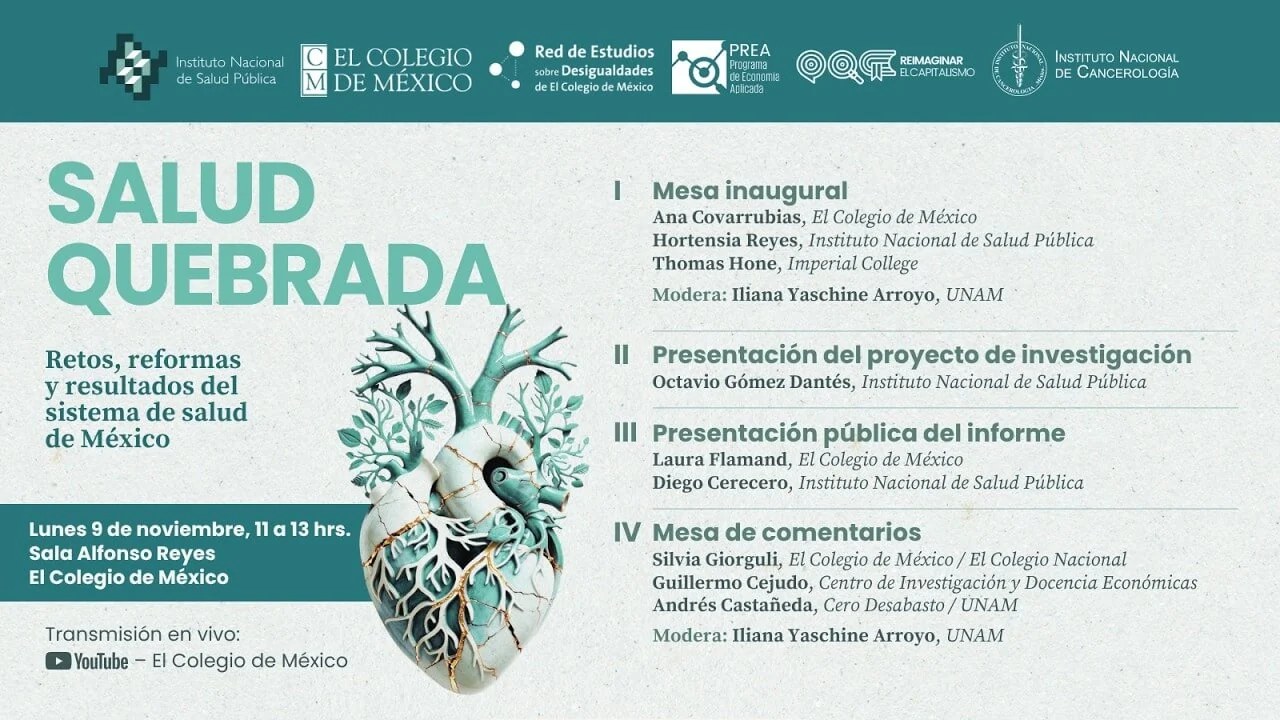
📖 The report behind the column. "Salud quebrada. Retos, reformas y resultados del sistema de salud de México" was presented on 9 November at [El Colegio de México](https://saludquebrada.colmex.mx/); its cover shows a broken heart. The authors, Octavio Gómez Dantés, Edson Serván Mori, Diego Cerecero García, Laura Flamand and Alejandro Mohar Betancourt, worked on it for four years. Castillo calls it required reading for everyone who designs health policy and budgets. According to a summary by the trade outlet Consultor Salud, the report finds, among other things, that 44.5 million people had no access to health services in 2024 and 5.7 million households faced excessive health spending. The share of households without insurance fell from 58.9% (2004) to 8.3% (2016) and climbed back to 31.4% by 2024. Households with excessive health costs became 73% more frequent between 2014 and 2024.
🩺 What the gap means for patients. The report finds the inequality in outcomes too: in the private sector breast cancer is caught early in 42.9% of cases, in the institutions for the uninsured in only 18.1%. Mexico counts more than 400 avoidable deaths per 100,000 people, against an OECD reference of 222. The authors propose raising public spending to 3.5% of GDP by 2030 and 6% by 2043, consolidating IMSS-Bienestar and forging a national pact for universal coverage. After the presentation, the state institutes INSP and INCan made clear that their researchers took part only as academics and that the institutes do not endorse the report.
🔄 Reform after reform. Castillo grants that Seguro Popular had flaws that deserved fixing. But replacing it with the Instituto de Salud para el Bienestar (Insabi), and then abolishing Insabi in turn, prolonged the uncertainty for millions of patients. For the new Servicio Universal de Salud, its budget and operating reach still have to be seen. It would be regrettable, he writes, if yet another generation had to wait for the next reform to exercise a constitutional right.
♿ Disability as a cost. Ahead of the International Day of Persons with Disabilities on 3 December, Castillo turns to the economic side: according to the statistics agency Inegi, 9.5 million people with disabilities lived in Mexico in 2024, 7.3% of the population, and their households spend more on health on average. Medicines, devices, therapy, home adaptations and care add up, as does income lost when relatives quit work to care for someone. With rare diseases, a diagnosis often takes years. He quotes Ingrid Medina, medical manager of the drug company BioMarin in Mexico, on comprehensive care for people with mucopolysaccharidoses, inherited and progressive diseases. Castillo calls for investment in medical training, diagnosis, research and access to new therapies, and for removing barriers in education and work.
💉 Vaccination. Finally, Castillo recalls that Mexico was once a global reference for vaccination and calls the loss of its recognition as free of endemic measles transmission worrying. The decline in vaccination coverage began before the Covid-19 pandemic, he writes; the changes to consolidated purchasing and supply of medical goods under López Obrador deserve rigorous examination, as does the impact of the pandemic. Regaining lost ground means rebuilding institutional capacity that took Mexico decades to develop.