🏥 WHO chief Tedros in Venezuela to help a health system hit by earthquakes and doctor exodus
In brief
- 🛬 WHO Director-General Tedros Adhanom Ghebreyesus arrived in Venezuela on Thursday for talks with the government on technical cooperation.
- 🩺 According to the Pan American Health Organization (PAHO), the agenda includes emergency preparedness and fair access to medicines and vaccines.
- 🌍 The country is recovering from the 24 June earthquakes, and about 43,000 doctors have left, according to the national medical federation.
- 💉 Paediatricians want more vaccines bought through PAHO's fund.
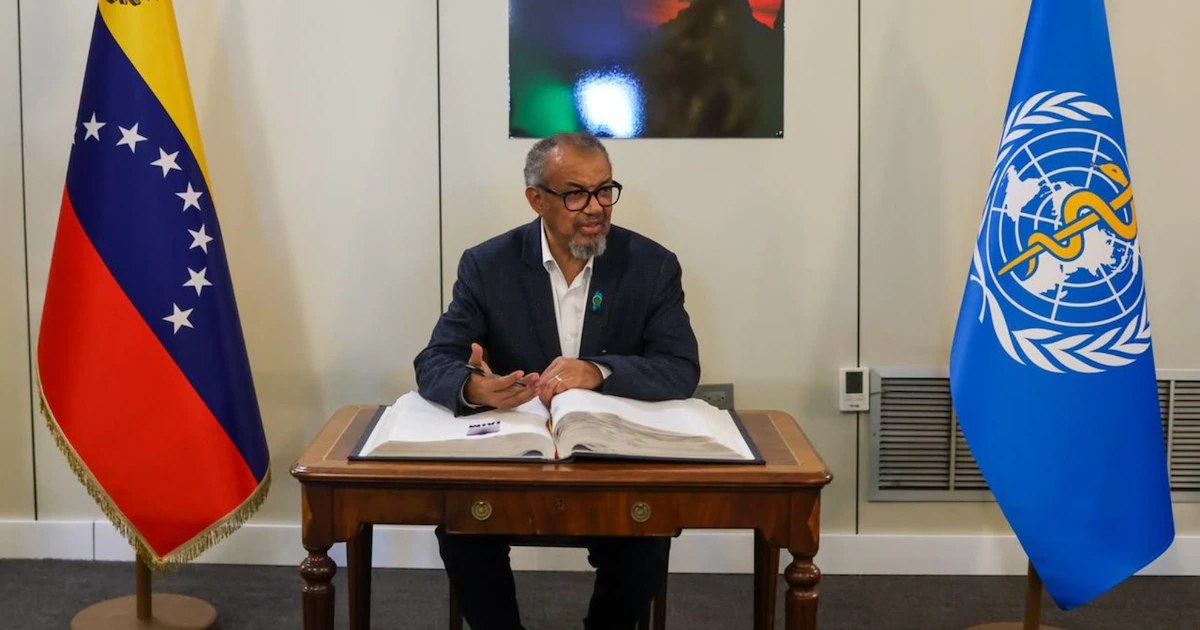
🛬 The Director-General of the World Health Organization (WHO), Tedros Adhanom Ghebreyesus, arrived in Venezuela on Thursday, 26 November. According to a press note from the [Pan American Health Organization](https://www.paho.org/es/venezuela-republica-bolivariana) (PAHO), WHO's regional office for the Americas, he is meeting national authorities to review progress and deepen the priorities of technical cooperation. The aim is to strengthen the public health system and its capacity to care for the population. 🩺 PAHO says the talks will cover, among other things, emergency preparedness and equitable access to medicines and vaccines. At Maiquetía airport near Caracas he was received by officials of the foreign and health ministries and by WHO's country representative, Armando De Negri Filho. 🌍 The visit comes at a hard moment: Venezuela is rebuilding its health network after the severe earthquakes of 24 June, many health workers have left the country, and WHO warned in July of a high risk of measles outbreaks because of low vaccination coverage. What concrete agreements the visit will produce is still open.
🤝 **Who met him.** At Simón Bolívar International Airport in Maiquetía, La Guaira state, the WHO chief was welcomed by Asbina Marín, director of sustainable development in the vice-ministry for multilateral affairs. Armando De Negri Filho, the WHO and PAHO representative in Venezuela, and officials of the Ministry of Popular Power for Health were also there. The news agency EFE and Infobae reported the arrival; PAHO lists its note on the visit on its Venezuela page.
🏚️ **The legacy of the earthquakes.** Two strong quakes hit Venezuela on 24 June; PAHO's situation reports give their magnitudes as 7.2 and 7.5. Three weeks later the health ministry reported 16,740 injured people and 107 temporary camps housing 20,936 people, according to PAHO. At the time PAHO flew in 27 tonnes of medicines, supplies and surgical equipment from WHO's logistics hub in Dubai, including kits for up to 1,000 operations, funded by the UN's CERF emergency fund and the EU's ECHO. PAHO Director Jarbas Barbosa told EFE in July that the reconstruction should also fix weaknesses that predated the disaster, such as access to drinking water and power cuts at clinics.
👩⚕️ **The staffing problem.** The emigration of doctors is seen as one of the biggest obstacles. Enrique Santiago López-Loyo, a former president of the National Academy of Medicine, cited figures in October from the Venezuelan Medical Federation saying about 43,000 doctors have left the country. In his words, this makes a gradual recovery of care ever harder. The UN refugee agency UNHCR estimates that about 7.9 million people have left Venezuela over the past decade.
💉 **Vaccination as a weak spot.** In July WHO warned of a high risk of outbreaks of vaccine-preventable diseases. PAHO's emergencies director, Ciro Ugarte, said coverage against measles and other diseases had already been low before the quakes. The Venezuelan Society of Childcare and Paediatrics (SVPP) urges the health ministry to buy the vaccines of the national immunisation programme through PAHO's Revolving Fund and to add vaccines against pneumococcus, rotavirus, hepatitis A, chickenpox, HPV and influenza. According to the society, the programme has missed its coverage targets for the past ten years.
📋 **What is still missing.** So far only PAHO's description of the topics is available; no results, pledges or sums have been announced. Whether Tedros will visit hospitals in the earthquake zones or announce new programmes is not known.
Sources
- Llega a Venezuela el director general de la OMS (ABC Color / EFE)
- El director de la OMS llegó a Venezuela para fortalecer el sistema público de salud (Infobae)
- Llega a Venezuela el director general de la OMS para profundizar cooperación técnica (Infobae / EFE)
- OPS/OMS apoya la respuesta al terremoto en Venezuela con 27 toneladas de medicamentos (OPS/OMS (PAHO/WHO))
- PAHO Venezuela page listing the note on Tedros' arrival (OPS/OMS (PAHO/WHO))