🇪🇺 EU special summit on the budget to 2034 breaks off without agreement
In brief
- ⏹️ The Brussels special summit on the EU budget for 2028 to 2034 ended just after midnight without a result; Friday's session was cancelled.
- 💶 Council President Costa's compromise of €1.78 trillion found no majority: too high for the savers, too low for southern and eastern Europe.
- 🗣️ Chancellor Merz still hopes for a deal by year-end and rules out new EU debt.
- 📅 Next attempt on 17 December; a €45 billion loan for Ukraine is also postponed.
⏹️ The special summit of the 27 EU countries on the next long-term budget has failed. Council President António Costa ended the meeting in Brussels, which had begun on Thursday morning and was planned for two days, shortly after midnight. "We know that we will not reach a result tonight," German Chancellor Friedrich Merz said; the planned continuation on Friday was called off. 💶 On the table was Costa's compromise for the 2028 to 2034 financial framework of €1.78 trillion, €204 billion less than the European Commission's proposal. Germany and six other net payers, who call themselves the "Sensible Seven", still consider that too much. A large group of mainly southern and eastern European states wants no further cuts to regional aid and farming. Italy's Prime Minister Giorgia Meloni said a deal was "light years" away. 📅 The leaders want to try again at their summit on 17 December. Merz said he was confident a deal could be reached by the end of the year. The budget must be in place by January 2028 and still needs the approval of the European Parliament. A €45 billion loan for Ukraine was also pushed to December.
🧭 **How the summit went.** Costa first tried to soften the fronts in the so-called confessional procedure: confidential talks with single countries and small groups. Later he split the leaders into smaller, geographically mixed rounds. According to Euronews, the savers felt singled out and boycotted the format; Costa carried on without them. After about fourteen hours no movement was visible. "This summit was a necessary step in the process," Costa said afterwards in his defence, ZDF reports.
🏛️ **The two camps.** The "Sensible Seven" are Germany, the Netherlands, Austria, Sweden, Denmark, Finland and, recently, Belgium. They want the budget to grow only moderately and to steer more money to defence, innovation and competitiveness. Facing them are the 17 "Friends of Cohesion", mostly net recipients in southern and eastern Europe. France and Italy add to the pressure: they are net payers too, but want to avoid losses for their farmers and regions. "We are not prepared to put our signature to a budget into which we pay more to get less," Meloni said. Hungary's Prime Minister Péter Magyar put the chances of a deal at "practically zero".
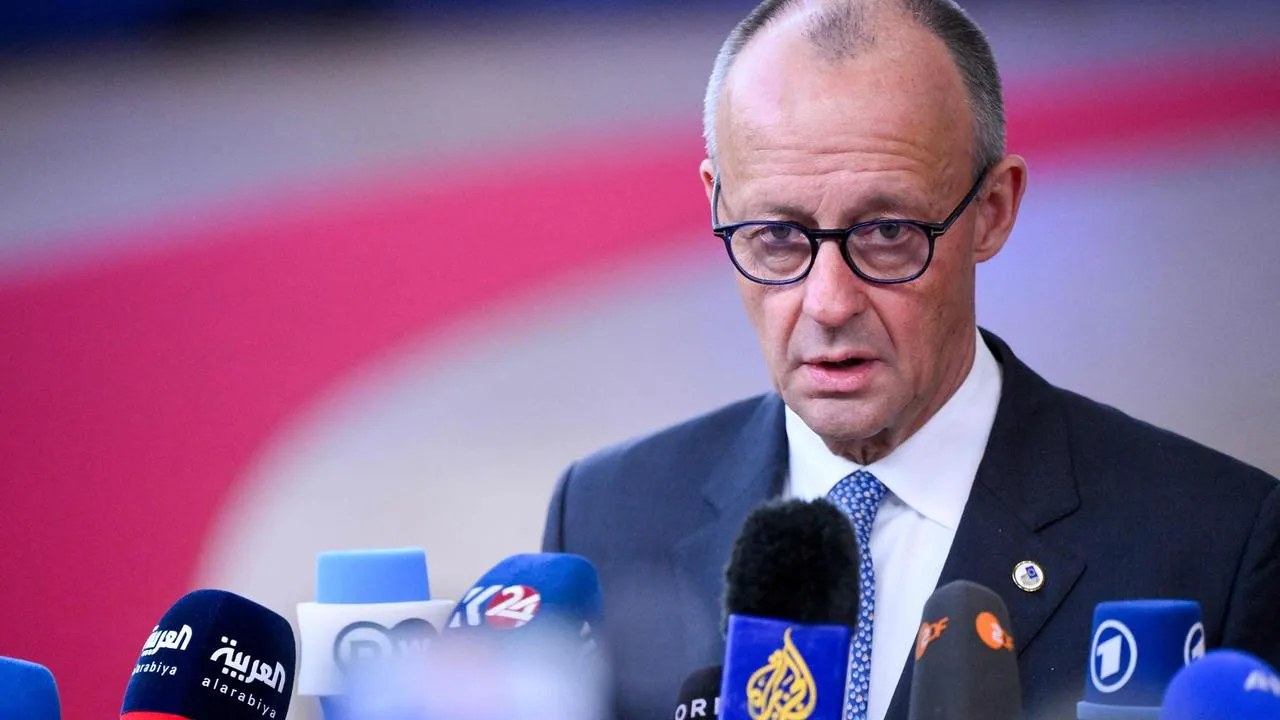
💬 **What Merz demands.** The EU budget "cannot grow without limit, and the burdens must be shared fairly," the chancellor said; "we are not there yet." He ruled out new debt at European level: interest of more than €150 billion would weigh on the next financial framework over its seven years. Merz also wants to keep the rebates for large contributors. Germany, he said, finances about a quarter of the budget and gets only about eight percent back. In his view the rounds so far point to a further cut of the proposals.
🇫🇷 **Tension between Berlin and Paris.** France's President Emmanuel Macron held a press conference of his own and presented himself as the broker. According to Euronews he threatened to break off the negotiations after 31 December. Merz replied that there were 27 bridge builders, not just one. Dutch Prime Minister Rob Jetten, by contrast, said: "For me there is no deadline."
⏳ **Why time matters.** Merz pointed to elections next year, among them in France, Italy and Poland, which would not make negotiations easier for the sitting governments. The new framework has to be ready for use by January 2028, and after a deal it still needs the European Parliament's consent.
🇺🇦 **Ukraine aid in the shadow.** The second item on the agenda, a €45 billion loan meant to finance Ukraine next year, was largely lost in the budget row. Hungary, Slovakia and the Czech Republic still refuse to take part. Merz insisted that all members join in future: the EU consists of "27 and not 23 or 24" states. This question, too, moves to December.
🏦 **One decision after all.** On the sidelines, Euronews reports, the leaders confirmed Spain's Pablo Hernández de Cos, currently head of the Bank for International Settlements, as the next President of the European Central Bank.