🩺 Apple launches a study of how people use AI for health questions
In brief
- 🆕 Apple launched the Apple Health AI Usage Study app on November 15 together with provider OpenEvidence.
- 🔢 Up to 200,000 US participants aged 21 or older ask health questions for up to 12 months; answers draw on medical journals.
- 🛡️ Data is anonymised and not used for AI training; OpenEvidence deletes it after 24 hours.
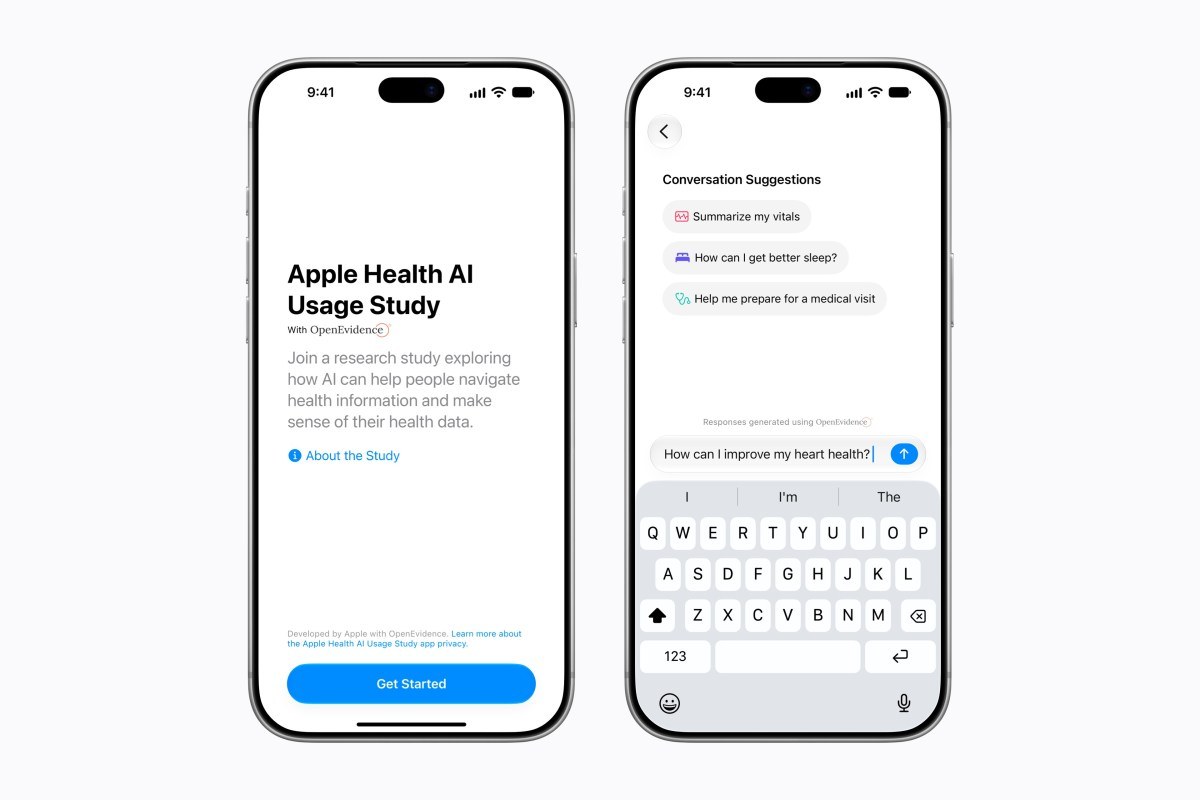
📱 Apple launched a study with its own app on November 15, 2026 to examine how people use artificial intelligence for health questions. The partner is OpenEvidence, an AI platform built for doctors. Up to 200,000 people in the US aged 21 or older with an Apple Intelligence-capable iPhone can take part for up to 12 months. They ask health questions answered from sources such as the New England Journal of Medicine, JAMA and Nature, rate the answers and complete monthly surveys. They can optionally share HealthKit data such as resting heart rate, sleep or lab results. Apple says the data is anonymised, not used to train AI models, and deleted by OpenEvidence after 24 hours. Whether the feature will reach the Health app or Siri is unclear.
The app is called Apple Health AI Usage Study. Apple wants to find out whether users understand the information, trust it and find it helpful, in other words comprehension, response quality, drivers of trust and everyday health actions. CNET notes that the study follows Apple's research programme since 2019, which has covered topics such as hearing, heart health and women's health. OpenEvidence is the partner; according to CNET, answers draw on sources including the New England Journal of Medicine, the Journal of the American Medical Association, the National Comprehensive Cancer Network, Nature and the Cochrane Database of Systematic Reviews, with linked citations.
According to TechCrunch, people in the US aged over 21 with an iPhone that supports Apple Intelligence (iPhone 15 Pro or later, per CNET) running iOS 26 or later can take part. Apple's on-device models classify things such as the question category. Participants ask about general health, symptoms, recovery from a procedure or their own uploaded data, and rate each response. There is a baseline survey, monthly surveys and extra surveys on preparing for doctor visits; participants who do not take part at all may be removed. Apple Watch users get check-in reminders, and for worrying medical topics the app guides users to providers.
On privacy, Apple said data is anonymised before it goes to a secure third-party cloud provider and is not used to train AI, and that OpenEvidence deletes queries and responses after 24 hours. Apple's vice president of Health and Fitness, Sumbul Desai, called a dedicated study the most thoughtful way to understand how people engage with and evaluate health AI. For context, CNET reports that one in three US adults use AI chatbots for health information, and OpenAI said earlier this year that users ask over 300 million health questions a week. TechCrunch notes it is unclear whether Apple plans to bring AI-powered answers to its Health app or Siri.