UK net migration drops to 77,000, the lowest since 1997 outside the pandemic 📉
In brief
- 📉 Net migration was a provisional 77,000 in the year to June 2026.
- 📊 It was 204,000 a year earlier and 944,000 at the peak.
- 🌍 Far fewer people arrived from outside the EU+ in particular.
- ⚠️ The figures are provisional; the estimate for British nationals is especially uncertain.
📉 Long-term net migration to the UK stood at 77,000 in the year to June 2026, according to provisional estimates published on November 26 by the Office for National Statistics (ONS). The office now puts the preceding twelve months, after revision, at 204,000. 📊 Leaving aside the pandemic, when travel was restricted, this is the lowest figure since 1997. It is a long way down from the peak of 944,000 in the year to March 2023. The main reason for the latest fall is that many fewer people from outside the EU+ arrived for work, study and asylum. The numbers may still be revised.
🧮 **Behind the headline.** A long-term move means twelve months or more. Some 738,000 people arrived, 17 percent fewer than the 893,000 of the previous period; in the year to March 2023 the count was 1,469,000. Another 661,000 left, compared with 689,000.
🌍 **Three groups, different directions.** For non-EU+ nationals (EU+ means the EU plus Norway, Iceland, Liechtenstein and Switzerland) arrivals still exceeded departures by 258,000, down from 379,000. Among British nationals, 137,000 more left than arrived, and among EU+ nationals the gap was 45,000.
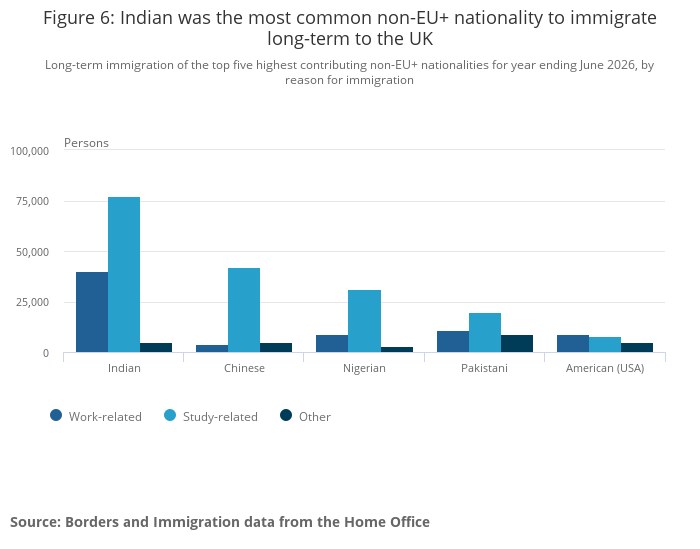
💼 Within non-EU+ immigration, arrivals for work fell by a quarter to about 135,000, arrivals for study by 11 percent to 257,000, and asylum-related arrivals from 93,000 to 73,000. Study is still the most common reason at 47 percent, followed by work at 25 and asylum at 13 percent.
🛂 Home Office visa data point the same way. From January to June 2026, visa grants to international students were down 38 percent on a year earlier (39,200 fewer). Grants to skilled workers, including health and care staff and their dependants, also fell 38 percent (26,300 fewer).
✈️ **Who is leaving.** Of the 292,000 non-EU+ nationals who emigrated, about 53 percent had originally come on study-related visas. Departures of EU+ nationals dropped 15 percent to 124,000. Around 245,000 British nationals moved away, a level broadly stable over five years.
⚠️ **Handle with care.** The ONS calls the estimates provisional. Updated data from the Department for Work and Pensions were unavailable, so figures for British nationals were projected forward over 15 months and carry more uncertainty than usual. The office is also working with the Home Office on a data problem affecting family migration estimates.
🏛️ **Politics.** The Guardian attributes the drop to policies pushed through by both Labour and Conservative governments. Labour promised in 2024 to cut net migration. Andy Burnham's arrival in Downing Street has signalled a shift in how legal migration is viewed, the paper writes; some Labour insiders say economic demand now drives policy more than concern about Nigel Farage's Reform UK.