⚛️ Taiwan votes to bring back nuclear power as referendum against 'nuclear-free homeland' passes
In brief
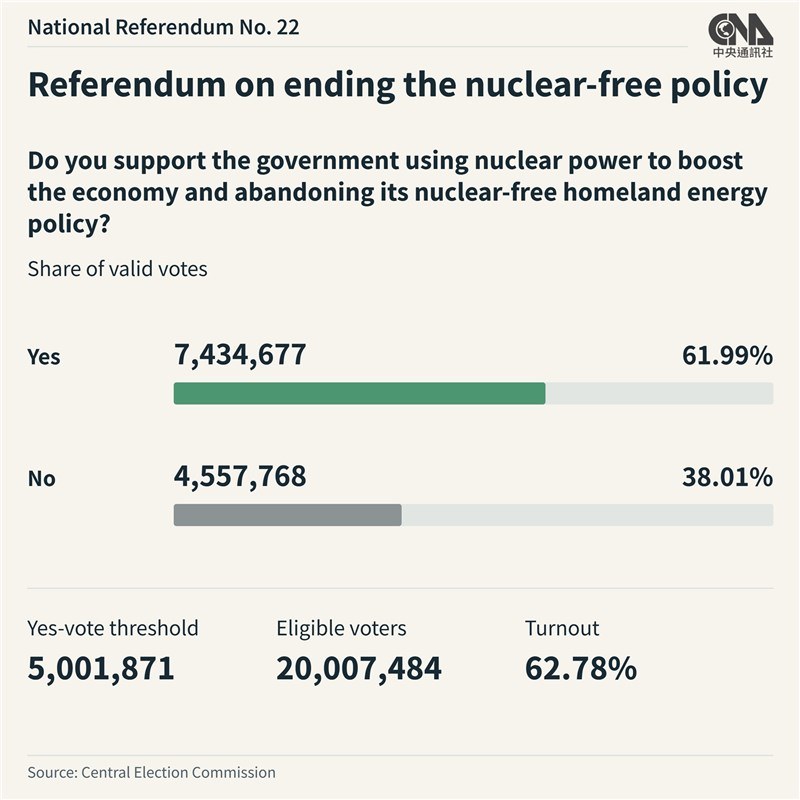
- 🗳️ About 7.43 million voters said yes on Saturday, well above the 5 million threshold.
- 📊 62 percent of valid votes in favour, turnout 62.79 percent.
- 🏛️ The Cabinet respects the result but sets three conditions: nuclear safety, a waste solution and social consensus.
- ⚠️ No reactor restarts automatically: reviews and approvals are still needed.
⚛️ Voters in Taiwan on Saturday approved a referendum backing the use of nuclear power to boost the economy and the abolition of the government's "nuclear-free homeland" energy policy. According to Central Election Commission (CEC) figures reported by the Taipei Times, 7,434,677 people voted yes and 4,557,768 voted no, just under 62 percent of valid votes. That comfortably cleared the legal threshold of one quarter of the roughly 20 million eligible voters, or 5,000,959 votes. 🗳️ The referendum was proposed by the opposition Kuomintang (KMT) with support from the smaller Taiwan People's Party, which argue that nuclear power ensures stable, affordable electricity for the energy-hungry chip and AI industries. The ruling Democratic Progressive Party (DPP) and anti-nuclear groups say safety and nuclear waste remain unresolved. The Cabinet said it respects the outcome but will keep pushing renewables and proceed cautiously on nuclear power. The vote does not automatically repeal any law or authorise the immediate restart of a reactor; Taiwan has had no nuclear plant online since May 2025.
🏛️ What the government says now. Cabinet spokesperson Michelle Lee said the government's position on nuclear power is unchanged, according to the Taipei Times. Three principles decide: nuclear safety, a solution for nuclear waste and social consensus. At the same time, the Cabinet wants to pursue a "second energy transition" by accelerating renewable energy. The news agency CNA points out that the result gives the government a public mandate to reconsider the nuclear-free homeland policy, but does not repeal existing statutory provisions.
🔧 What a restart would take. Any resumption of nuclear generation requires technical assessments and regulatory approvals, including reviews of reactor safety and waste management. The government had already been moving before the vote: President Lai Ching-te signalled a more open approach in March 2026, citing rising electricity demand from artificial intelligence, carbon-reduction requirements and geopolitical risks. On March 21 he said work had begun on approvals to restart the decommissioned Kuosheng plant (No. 2) in New Taipei's Wanli District and the Maanshan plant in Pingtung. State-run Taiwan Power Co. is preparing restart plans for review by the Nuclear Safety Commission, CNA reports. Maanshan was the country's last reactor to shut down, on May 17, 2025.
⚖️ The arguments on both sides. Supporters say nuclear fuel can be stockpiled more easily than imported natural gas, making Taiwan more resilient in case of geopolitical tension or supply disruption, and that nuclear and renewables can grow in parallel, with nuclear providing stable baseload power. Opponents counter that plants built near geological faults lack sufficient earthquake resistance and that new construction is too costly and slow to keep pace with the tech sector's soaring demand. The DPP argued the referendum did not say which plants should restart, how long it would take or how long-term waste management would work. The National Nuclear Abolition Action Platform called the wording about "using nuclear power to revitalize the economy" subjective and described the vote as a push poll; the result is no blank cheque, it said.
📈 A vote with a history. It was the fourth nuclear referendum in eight years. In 2018 voters removed the legal deadline to phase out nuclear power by 2025; in 2021 a proposal to activate the mothballed Fourth Nuclear Power Plant in Gongliao failed. In August 2025 a referendum on keeping Maanshan running won about 74 percent of valid votes but missed the quorum. This time the question addressed energy policy as a whole and was held alongside the nationwide local elections, which lifted turnout to 62.79 percent. The yes votes equal 37.17 percent of all eligible voters. The result still has to be formally confirmed by the election commission.